Evanston report finds concentrated environmental burdens in four wards, urges coalition and policy action
Loading...
Summary
A consultant presentation to the Equity & Empowerment Commission identified concentrated environmental disparities in Evanston’s 5th, 2nd, 8th and 9th wards and recommended an umbrella coalition, a tracking dashboard and targeted 'green zones' to prioritize trees and capital investment.
Evanston—Consultants and local advocates at the Equity & Empowerment Commission meeting on Feb. 19 presented an Environmental Equity Investigation that maps decades of disparate outcomes across parts of the city and recommends coordinated action to reduce those burdens.
Brett Bridal, a landscape architect and principal at MKSK, told the commission the firm spent more than a year engaging residents through pop-ups, workshops and focus groups to document how past policies and present practices have produced unequal burdens. "What we were trying to do is investigate further…what are some of the current and past policies, practices, and priorities that have perpetuated unequal burdens and barriers to opportunities across Evanston," Bridal said.
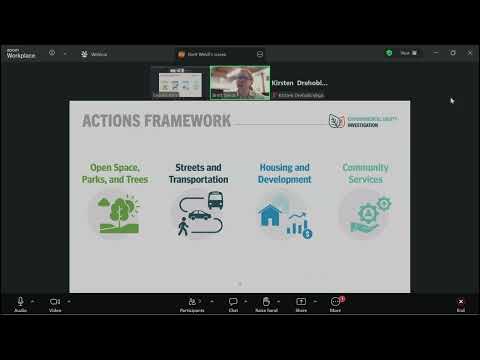
The team overlaid census, income and health data and identified the 5th, 2nd, 8th and 9th wards as focus areas with overlapping indicators—lower household income, lower life expectancy and higher racial segregation—where residents face systemic disadvantages, Bridal said. The report’s action matrix lists potential projects, policy changes and programs and assigns likely lead agencies and community partners for each action.
Among the report’s priority recommendations are establishing "green zones" to prioritize tree replacement and canopy in the most affected neighborhoods, integrating environmental equity into capital planning and ordinances, and creating a public-facing environmental-justice tracking dashboard to monitor progress over time.
Advocates who helped draft the city’s 2020 Environmental Justice resolution said the investigation advances recommendations the resolution envisioned but that three resolution items remain unfulfilled. "The resolution called for an ordinance with teeth, a public-facing interactive EJ map and a finalized public-engagement policy," said a representative of Environmental Justice Evanston. Presenters said an EJ map exists but is not yet user-friendly and the proposed public-engagement policy—developed by the sustainability team—has not been finalized or widely implemented.
Long-time resident and Environmental Justice Evanston co-chair Janet Alexander Davis described the lived effects of those disparities: fewer trees, constrained front-yard tree planting due to historic zoning and slow service responses. "This is why zoning is so important," she said, and urged coalition building so multiple groups can coordinate influence and turnout.
Speakers also raised community concerns about the location and operations of a local waste-transfer station. One presenter said, "I hear there's 40 trucks that go down Church Street every day," describing traffic, noise and air-quality burdens in predominantly Black and Brown neighborhoods. That statement was offered as testimony and was not accompanied by an independent count in the meeting record.
Commissioners focused questions on implementation and next steps. Bridal said forming an umbrella justice coalition—bringing together community groups, nonprofits and city staff—was a realistic short-term win that could accelerate work already underway and help city leaders and residents coordinate on policy changes. She also noted the MKSK contract is ending and recommended the coalition take up the ongoing work of coordination.
The presenters pointed to several immediate steps for the commission and city staff: review and improve the city’s EJ map for public use, finalize and publicly discuss the draft public-engagement policy, evaluate the feasibility of using the equity scorecard in decision-making, and pursue ordinance language that would commit the city to measurable actions.
At the meeting the commission agreed to follow up: staff will ensure the action matrix and referral tracker are included in future packets for commissioner review, the commission will promote the equity scorecard survey in community events and at a scheduled expo, and commissioners discussed bringing coalition representatives back to present implementation plans.
Meeting decisions and votes - Approval of minutes: The commission approved the Jan. 15 minutes by voice vote after a quorum was achieved. - Chair nomination: Co-chair Jones nominated Josephine Bostick to remain chair for 2026–27; the nomination was seconded and approved by voice vote. Chair Bostick accepted. - Calendar change: Commissioners voted to cancel the Aug. 20, 2026 regular meeting and table scheduling a retreat for future discussion.
What’s next The report is available online and presenters asked the commission to treat the study as a roadmap: improve public-facing tools, convene a justice coalition to sustain momentum after the consultant contract ends, and pursue ordinance-level commitments. Commissioners directed staff to put referral materials and the scorecard results in the next packet and to coordinate community outreach for fuller public engagement.
(Reporting based on the Feb. 19, 2026 Equity & Empowerment Commission meeting transcript.)