Get Full Government Meeting Transcripts, Videos, & Alerts Forever!
Get email alerts on the Harmful Algal Blooms topic
No spam. Unsubscribe anytime.
Utah Division of Water Quality details HAB monitoring and public messaging for Utah Lake
Summary
Ellen Bailey of the Utah Division of Water Quality outlined the agency’s seasonal monitoring, lab testing and advisory framework for harmful algal blooms at Utah Lake, and said coordinated signage, media outreach and volunteer reports help recreators make informed decisions.
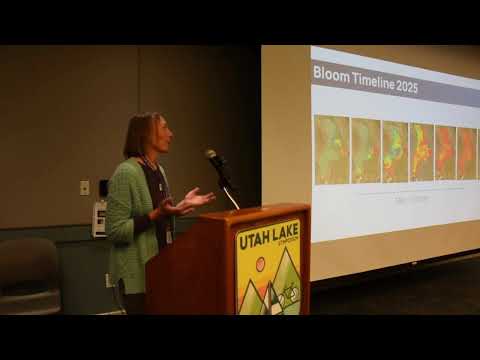
Ellen Bailey, with the Utah Division of Water Quality, described the state’s approach to monitoring and communicating about harmful algal blooms (HABs) at Utah Lake, saying the work aims to help recreators make informed decisions about safety.
Bailey said the division begins sampling in May or early June as recreation increases and visits priority sites at least monthly. "Our ultimate goal is that everybody knows, understands, about harmful algal blooms and knows what to look for to stay safe," she said. The division also relies on volunteer monitors (the USU HAP squad) and public reports via the SPILLS line to prompt additional sampling when conditions change.
The agency sends samples to laboratories that test for toxigenic cyanobacteria (cell counts) and to a separate lab that analyzes actual toxin concentrations. Data are maintained on a live sheet the division shares with partner agencies to coordinate consistent public messaging.
Bailey described a guidance framework developed with the U.S. Environmental Protection Agency and local partners that sets advisory levels and recommended actions. She said the division uses a ‘‘Healthwatch’’ category when there is suspected risk and a ‘‘warning’’ advisory tied to measured thresholds; she noted a cell-count threshold “around 100,000” cells as a trigger that would move officials to issue a warning advisory. A higher “danger” advisory is used for elevated toxin or cell levels that indicate increased short‑ or long‑term health risk.
To reach recreators, the division deploys both permanent signs at major access points and temporary advisory signage that clearly shows which activities are recommended or discouraged under each advisory level. Bailey gave examples: when blooms are present, swimming is discouraged because of the risk of ingesting contaminated water; boating is generally permitted; paddling carries some risk if it is likely someone will end up in the water.
Bailey cited a public perception survey the division conducted last summer: among recreators who knew about HABs, 75% said they first heard about them through news stories, 54% saw signs at a water body, and 35% learned from friends or family. She said those results reinforce the need to work closely with news media, bolstered by signage and online resources such as habs.utah.gov.
Bailey closed by inviting questions and feedback and by directing listeners to the division’s website for more information and updates.