
Wilsonville council agrees to study limits on town center height waivers, asks for communications plan
Get AI-powered insights, summaries, and transcripts
Sign Up Free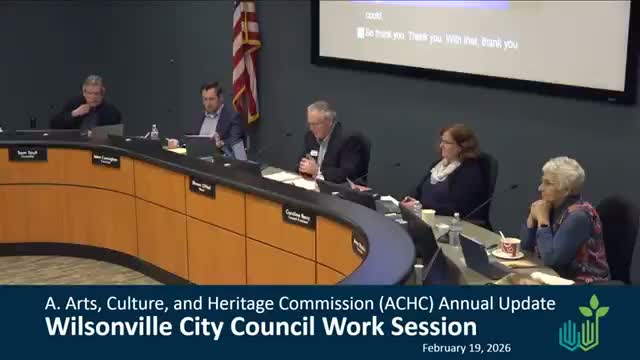
Summary
Councilors directed staff to return a resolution this month to explore narrowing building-height waiver language for parts of the town center, and backed a communications strategy to explain town center planning and urban-renewal financing to residents.
Wilsonville's City Council on Feb. 19 directed staff to return a resolution seeking to refine the town center's building-height waiver language and approved a staff-led communications approach to explain the plan and potential urban-renewal financing to residents. The discussion centered on whether the existing waiver process, which staff said currently allows height adjustments in the Commercial Mixed Use (CMU) and Mixed Use (MU) subdistricts without an explicit maximum, should be amended to add limitations.
City Attorney Amanda Veil Hinman and Assistant City Manager Gina Trojheim told the council the town center plan and development-code provisions were adopted as part of Wilsonville Code Chapter 4 (town center rules are in section 4.132) and that the waiver language currently provides a mechanism for height adjustments in the CMU and MU subdistricts. Trojheim said the city's 2025 housing needs and capacity analysis (adopted by ordinance on 06/16/2025) projects the need for 22,815 dwelling units over the planning horizon, with roughly half of the multifamily housing expected in town center; she warned that reducing housing opportunities in town center could put the city out of compliance with its state-approved housing production strategy and expose it to actions by the Oregon Department of Land Conservation and Development (DLCD) or Metro.
Councilors emphasized two competing priorities: preserving neighborhood character and maintaining the city's housing capacity. Councilor Cunningham said staff's initial review indicates scoped changes to the waiver language would not necessarily alter the housing-production assumptions, but that a follow-up feasibility and assumptions analysis is planned. "The very first building that's been permitted in town center ... is already getting the waiver and going to a 5-story level," Cunningham said, noting incentives that make higher floors attractive to developers.
Council members signaled support for pursuing changes to the waiver language within the calendar year, provided the effort focuses tightly on the waiver text so mandatory planning commission hearings and statutory notice can be met. Several councilors favored creation of a limited-duration task force that would include past town center participants and fresh voices; staff said the resolution returned to the council would outline the proposed timeline and public-input approach. City attorneys also advised a regulatory-takings risk assessment before imposing any across-the-board caps on residential opportunity.
CFM Advocates, the city's communications consultant, presented a draft outreach strategy intended to clarify how the town center plan and urban-renewal financing work, provide plain-language explainers and translated materials (Spanish), host town halls and supply multimedia content. Gary Conklin of CFM summarized the core message: "The Wilsonville Town Center will become the heart of our community with local restaurants, entertainment venues, unique retail outlets, walkable open spaces and ample parking." The firm said the plan will tailor communications for different audiences, use the city's social channels, and prioritize in-person engagement at community events.
Next steps: staff will return a resolution at the next council meeting to begin the code-review process for the waiver language and will bring additional analysis on housing and financial-feasibility assumptions at an upcoming work session. Councilors asked staff to ensure the outreach plan addresses concerns from seniors and other groups less likely to use social media.
The council did not adopt code changes at the meeting; the action requested was direction to pursue scoped code revisions and community engagement that would be subject to Planning Commission review and required state and Metro notification.