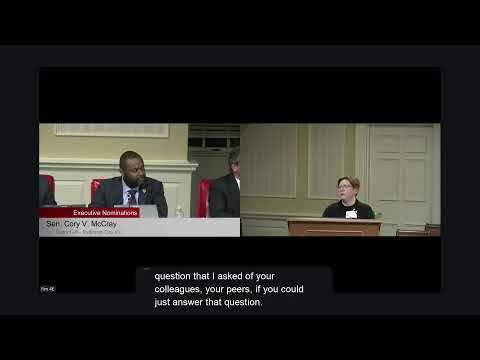
Public Service Commission chair nominee faces sustained questioning on high electric bills
Loading...
Summary
Kumar Barve, nominated to chair the Maryland Public Service Commission, told senators he intends to be a 'hard-nosed accountant' while answering extensive questions about why Maryland's electricity bills are high and how the PSC factors climate, labor and market rules into rate-setting.
Kumar Barve, the governor's nominee to chair the Maryland Public Service Commission, told the Senate Executive Nominations Committee on Feb. 16 that his top priorities would be affordability, reliability and careful accounting as the commission addresses high electricity bills in Maryland.
Introduced by Senator Cheryl Kagan, Barve described his background in accounting and public service and said the commission's role is to protect ratepayers by scrutinizing utility spending and market rules. Senators repeatedly pressed him about rising bills, the effects of PJM market dynamics and policy-driven costs the commission must weigh. Barve said the commission recently cut a funding request from utility BGE in half and emphasized oversight of auctions and transmission issues controlled by the Federal Energy Regulatory Commission and PJM.
On multiyear rate-making and reconciliation, Barve said the commission is conducting a "lessons learned" review and that any public positions would await that evidence to avoid recusal problems. Senators also asked how legislative directives — including mandates to consider labor and climate in rate-making — affect the cost borne by ratepayers; Barve said there is no inherent incompatibility among those goals but that they must be implemented carefully.
Barve urged a diversified approach to generation and said the PSC should move projects — natural gas, renewables, batteries and transmission — "fast but break nothing." He also said the commission is expanding oversight of PJM rules and wants to ensure the market does not result in paying for "phantom load."
Next steps: The committee heard extended questioning and recorded no formal objections in the transcript; any confirmation would follow the committee's procedural steps.