
Pike County fiscal court opens formal review of landfill options after social‑media controversy
Get AI-powered insights, summaries, and transcripts
Sign Up Free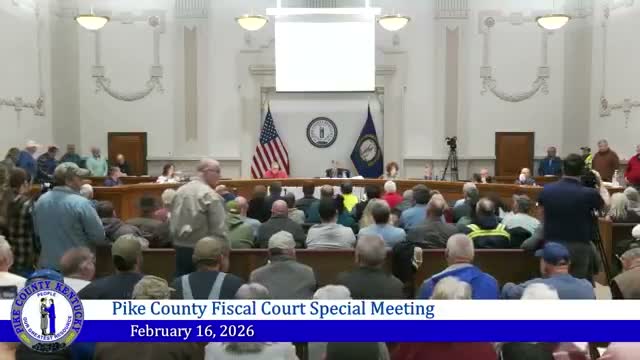
Summary
At a special Feb. 13 meeting, Pike County’s fiscal court detailed three options for handling a rapidly filling county landfill — expand the existing site (estimated $18M), close and haul waste out (~$6M closure cost plus hauling) or allow a private company to seek permits for a new landfill on a former mine site — and stressed the host agreement voted earlier was only for exploration and permitting, not construction.
Judge Jones opened a special meeting of the Pike County Fiscal Court on Feb. 13 to address persistent social‑media claims about a proposed landfill and to explain options for the county’s rapidly diminishing landfill capacity.
Jones told the assembled residents that the court had not authorized construction at Myra and that recent votes were limited to soliciting proposals and allowing a private company to pursue permitting steps. “You’ve been lied to,” Jones said, describing posts he said misrepresented the court’s actions. He emphasized the court had voted in open session only to solicit requests for proposals and to accept a single returned proposal and a related host agreement — steps Jones characterized as preliminary and required to permit further study.
Why it matters: Pike County’s landfill, opened in 1993, has accepted waste for about 34 years and faces shrinking airspace. County officials said emergency state funding and short‑term measures will buy about six‑to‑seven years of capacity, after which a successor fiscal court will face costly choices that could affect garbage rates and county finances.
Jones reviewed three paths the court is weighing: expand the existing landfill on the current site (most recent county estimate: about $18 million), close the current site and haul county waste to another facility (closure cost estimate cited at $6 million plus hauling), or allow a private operator to seek permits for a new facility on a reclaimed mine property. He said the county received $4.7 million in state assistance to extend capacity temporarily and that an expansion permit for the existing landfill — itself costly and time consuming — took until March 2024 and required roughly $1.4 million in permit‑related expenses.
On the private‑proposal option, Jones presented details of the company the court has met with and described procedural safeguards that remain in place. He said the firm had invested preliminary engineering dollars (he cited about $500,000) and that a host agreement allows only preliminary site work and administrative permitting; any final site approval would require additional public notice, a formal petition under the county siting ordinance and a future fiscal‑court vote. “There’s a lot to be done down the road before the fiscal court would be even in a position to either vote yes or no,” Jones told the meeting.
County officials flagged technical and regulatory hurdles: engineers raised concerns about slope stability and the need to reach existing liners, mining voids under prospective sites could make landfill construction infeasible, and multiple state and federal agencies — the state Division of Waste Management, the Kentucky Department for Environmental Protection and Natural Resources, MSHA and the U.S. Army Corps of Engineers — would need to review permits and environmental impacts.
Supporters of studying the private proposal argued the option might reduce long‑term disposal costs and create construction and permanent jobs the county says it lacks. One commissioner said permitting and exploration would at least allow the county to evaluate whether a private facility could accept up to 65,000 tons per year and offer free disposal for a portion of the county’s tonnage; that same commissioner said the court’s vote was to explore feasibility, not to approve construction.
Tension and public reaction: The meeting drew numerous interruptions from residents. The judge and other court members repeatedly told attendees this special meeting would not include a public‑comment period. A county official who spoke apologized for a prior social‑media post and a subsequent threat directed at another family. Jones warned that disruptive behavior could result in removal.
What happens next: The county said the recent state money and short‑term measures will buy roughly six to seven years of capacity. Officials said the expansion of the existing landfill, if pursued, would need immediate initiation of permitting and funding (the court earlier obtained approval for up to $10 million in bonding), but that the likely full cost of a permanent expansion could be far higher. If the private company moves forward with an administrative permit application, a public hearing and county review steps are required before any site approval. Jones said the next fiscal court will likely face the final, difficult decision and encouraged residents to ask candidates how they would address future landfill costs.
Quotes (selected):
“You’ve been lied to,” Judge Jones said of social‑media posts that asserted the county had already approved construction.
“We got 4 and a half years,” Jones said of a prior engineering estimate of remaining life before the county secured short‑term measures.
“We ain’t got long to us — probably 6 months or so,” certified landfill manager Larry Hensley said when asked about remaining capacity on the current phase.
“I apologize to you all,” a county official (identified in the transcript by nickname) said after acknowledging a regretted social‑media post and related threats.
Ending: Court members said the host agreement and acceptance of a returned proposal in open court do not equate to a construction approval; they urged residents to follow the forthcoming permitting process and said any final site decision would return to the fiscal court for additional public review and a formal vote.