Economic Matters Committee advances five bills; new process gives subcommittee chairs lead in voting sessions
Loading...
Summary
The Economic Matters Committee moved five bills — HB 236, HB 241, HB 242, HB 259 and HB 308 — favorably in a single voting session after brief presentations by subcommittee speakers; committee announced subcommittee chairs will present bills and council members may participate in Q&A going forward.
The Economic Matters Committee held a voting session in which it moved five bills favorably and completed roll-call votes on each.
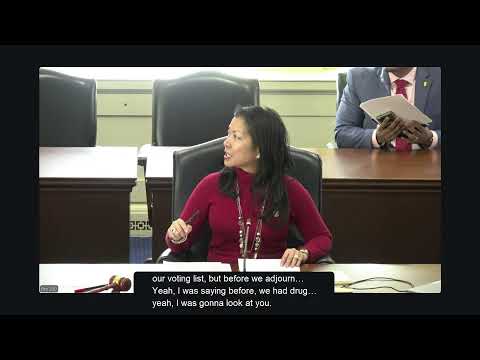
Chair Rogers opened the session and announced a procedural change: subcommittee chairs will now present bills under their jurisdiction while committee counsel will be available as backup and council members will be present for questions and answers. ‘‘The subcommittee chairs will now be the ones presenting since we're using our subcommittee infrastructure...questions will go to the subcommittee chair or counsel here for backup,’’ Speaker 1 said.
House Bill 236: The committee heard that HB 236 would extend the period during which blood-work results required to participate in Maryland State Athletic Commission events may be considered valid from 30 days to 90 days. An unidentified subcommittee speaker summarized the change as ‘‘extend[ing] the time frame from 30 to 90 days that blood work results required to participate in Maryland State Athletic Commission events may be considered valid.’’ The motion to report the bill favorable was moved and seconded; a roll-call vote recorded affirmative responses from Vice Chair Charcutian and a majority of delegates, with Delegates Cheese and Crosby recorded as excused. The motion carried.
House Bill 241: An unidentified speaker described HB 241 as extending the termination date for five occupational and professional licensing boards and commissions within the Department of Labor through July 2032. The committee moved the bill favorable, conducted a roll-call vote with recorded affirmative responses and excusals, and the motion carried.
House Bill 242: The committee heard that HB 242 alters requirements related to confidential unemployment insurance information to ensure compliance with applicable federal laws and regulations. The motion to report HB 242 favorable passed on a roll-call vote.
House Bill 259: An unidentified speaker, noting the bill was brought by the department, summarized HB 259 as updates to the community investment fund that would allow OFR to secure sufficient matching funds, extend the program timeframe by two years, and provide incentives intended to keep banks and credit unions participating. ‘‘[T]o allow for OFR to make sure it has enough money for matching funds and extends that time frame for 2 years,’’ the speaker said. The committee moved HB 259 favorable and recorded the roll-call vote; the motion carried.
House Bill 308: An unidentified speaker explained HB 308 as a clarification of the definition of ‘‘principal office’’ to allow smaller businesses to use a mailing address for the delivery of official correspondence. The motion to report HB 308 favorable was moved and seconded and passed on roll-call.
Votes at a glance: each bill was moved favorable, seconded, and approved by roll-call in the transcript provided. The recorded pattern across votes shows affirmative votes from Vice Chair Charcutian and a majority of delegates present; Delegates Cheese and Crosby are recorded as excused in the transcript. The motions as recorded in the transcript do not name who moved or seconded each motion.
All comments in the transcript attributing bill summaries were made by speakers identified in the record as subcommittee presenters (the transcript does not provide their full names). No amendments or substantive debate on the bills is recorded in the provided segments; each bill drew brief presentation and then a roll-call vote. The session concluded after the five bills were processed and the voting list was closed.