
Teachers, union and parents urge board to rescind layoffs and address large class sizes
Get AI-powered insights, summaries, and transcripts
Subscribe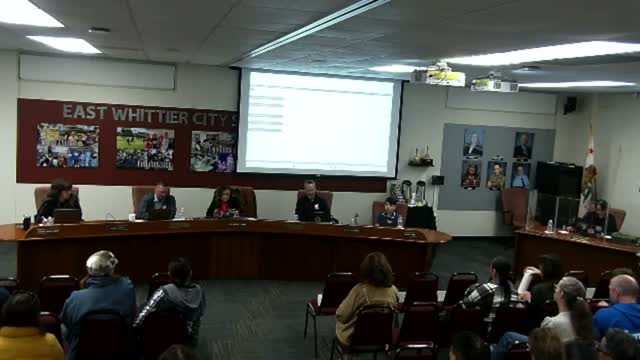
Summary
Dozens of teachers, classified staff and parents told the East Whittier City School District board that recent releases and proposed reductions threaten student services and safety, citing 10 classified staff still on a layoff list and classroom sizes reported as high as 37 students.
At a packed public-comment period, teachers, classified staff and parents urged the East Whittier City School District board to reconsider recent layoffs and hiring decisions that they say undermine instruction and student safety.
Laura Sullivan, a teacher at Ocean View, said long-term substitute "temps" have been rehired for years without job security and that 13 temps were officially let go at the last meeting. She said those staff are "our most vulnerable employees" and accused the district of notifying affected temps nearly 48 hours after the public meeting. Julia Gleick, a special-education aide of 25 years, asked the board to rescind initial recommendations to eliminate 24 classified positions (later reduced to 10 remaining) and noted that many of the roles targeted are low-hour but high-impact positions that do not carry benefits yet provide critical services to marginalized students.
Paul Reapson, a grounds worker of 18 years, criticized perceived disparity between administrator pay increases and the proposal to cut front-line employees, and asked the board to "prioritize people over paperwork." Lily Adena Cola, the district's roving LVN, described the continuity-of-care role nurses provide and urged the board to preserve nursing coverage that supports students with medical needs.
Multiple speakers highlighted class-size concerns. Laura Sullivan said her site may start the next school year with 37 students in a class; Lisa Fragoso and other teachers described widespread sections with 30–36 students, multiple students with IEPs and 504 plans, and difficulty implementing tiered instruction amid the high loads.
Speakers framed their pleas around funding projections and district processes. Julia Gleick cited Legislative Analyst Office projections suggesting higher state K–12 funding in 2026–27 (she referenced a potential 6% to 10% increase and a per-pupil figure rising from about $18,500 to roughly $20,400) and asked the board to consider rescinding layoffs in light of prospective revenues. Several public speakers and union representatives asked the board for clearer explanations of how LCAP (Local Control and Accountability Plan) priorities and stakeholder feedback were incorporated into staffing decisions.
District staff and board members acknowledged the comments during later presentations and action items, repeatedly saying reductions are tied to declining enrollment and master-schedule adjustments at some middle schools. The board did not take immediate action to rescind layoffs at the meeting; subsequent agenda items included formal resolutions that codify staffing adjustments and tie-break procedures for certificated seniority.
The next procedural step announced by the board was to continue LCAP community meetings (the district listed March 11 for the next session) and to move forward with the formal resolutions and consent items on the evening's agenda. Public speakers asked the board to keep returning to the question of whether the district could better preserve positions while achieving fiscal stability.