Get Full Government Meeting Transcripts, Videos, & Alerts Forever!
Get email alerts on the Zoning topic
No spam. Unsubscribe anytime.
Planning commission formalizes Santa Ana Zoo overflow parking, approves GP and zoning amendments
Summary
The Planning Commission voted to recommend City Council approve a General Plan amendment and a zoning change to formalize and improve the Santa Ana Zoo overflow parking lot at 1801 E. Chestnut Ave., allowing paving, ADA upgrades, EV chargers and about 250 spaces; the environmental document is an MND with mitigation measures.
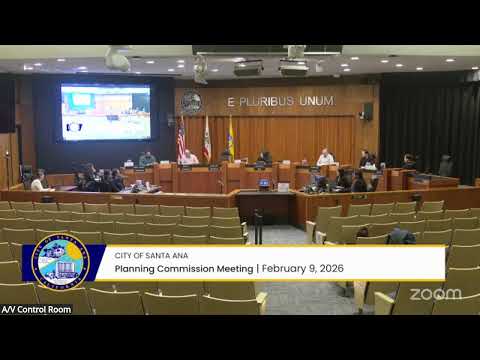
The Santa Ana Planning Commission voted unanimously (with Commissioner Oliva absent) to recommend City Council approve a General Plan Amendment (2025‑01) and a zoning amendment (2025‑02) to formalize the long‑standing Santa Ana Zoo overflow parking lot at 1801 East Chestnut Avenue.
Acting Public Works Director Rudy Rosas said the changes would reclassify the parcel from open space to general commercial (C2 zoning from A1) so the city can pave and improve the dirt lot, add striping and circulation improvements, provide ADA‑compliant parking, install electric‑vehicle charging stations and create roughly 250 parking spaces to serve peak zoo attendance. Rosas told the commission the proposal implements the 2018 zoo master plan and is intended to align land use and zoning with the site’s current operational use.
Staff presented an Initial Study and Mitigated Negative Declaration (MND) and a monitoring and reporting program (MMRP) that, according to the report, reduces potential impacts to less‑than‑significant with standard mitigation measures. Angela Wolf of First Carbon Solutions, the consultant on the environmental review, said the mitigation measures include preconstruction nesting‑bird surveys, cultural‑resource protocols and procedures to stop work and notify tribes and archaeologists if artifacts or human remains are encountered.
Commissioners asked about alternative designations and long‑term options. Commissioner Escamilla questioned why the parcel is not kept as open space, noting the city’s limited open‑space acreage and that some other parks contain parking within an open‑space designation. Rosas and staff replied that the overflow lot is a single, independent parcel envisioned in the zoo master plan for parking and that redesignation to C2 both reflects existing use and improves the city’s ability to pursue grants and outside funding for improvements. On the record, staff said grant programs and some funding sources require consistent land‑use and zoning classifications before they will commit funds.
Commissioners also discussed trees and event space. Staff said the grassy event area adjacent to the proposed lot would remain outside the parking boundary in the near term; some overgrown bushes and small trees would be removed for the proposed layout but appropriate replacement trees and landscaping would be included in plans.
The public hearing for the item drew no in‑person speakers (one email comment was received). Commissioner Escamilla moved and Vice Chair Benninger seconded approval; a roll call vote approved the recommendation to City Council unanimously with Commissioner Oliva absent. The staff report and MMRP will be forwarded with the commission’s recommendation for final consideration by the City Council.