Get Full Government Meeting Transcripts, Videos, & Alerts Forever!
Get email alerts on the Public Safety Fire Funding topic
No spam. Unsubscribe anytime.
Sumner County debate over volunteer fire funding centers on fire-tax referendum and ad hoc study
Summary
Public commenters and commissioners spent the meeting pressing for clearer plans to fund volunteer fire departments. Commissioners debated asking the state for authority to hold a fire-tax referendum, agreed to study options through an ad hoc committee, and approved a one-time rural fire distribution while referring broader funding proposals to budget.
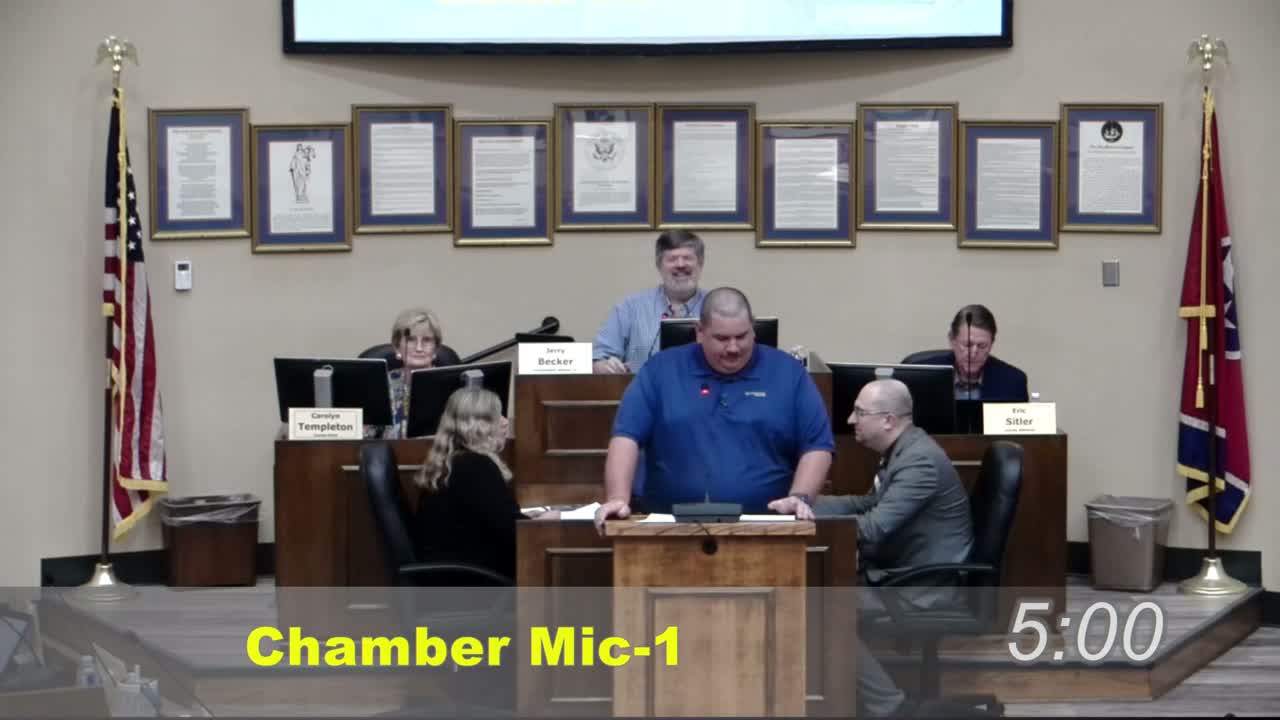
Commissioners and members of the public spent a large portion of the Sept. 16 Sumner County Board of County Commissioners meeting focusing on how to fund the county’s nine volunteer fire departments and whether to seek state permission for a fire-tax referendum.
Brad Williams, a volunteer firefighter (who gave his address during public comment), told the commission the current annual county allocation to volunteer departments is about $650,000, roughly $3.24 per county resident, and urged a clear multi-year plan for replacement of aging vehicles and equipment. Other speakers, including Wayne Drown and Curtis Williams, described worn apparatus, expiring personal protective equipment and widely varying call volumes among departments and urged action to avoid ISO downgrades that can raise homeowners’ insurance rates.
On the policy side, Commissioner Roger Shoaf (introducing item 2509-09) framed a request to the Tennessee Legislature for a private act allowing the county to put a fire-tax referendum before voters as "step one"—permission to study and, later, seek citizen input. Shoaf said the measure would not immediately change funding or create a tax; instead, it would allow the county to assemble options and educate residents. Other commissioners echoed that the ad hoc health and emergency services committee would gather volunteer chiefs and staff to define models, costs and coverage options before any referendum.
Opponents said the move risked opening a long-term tax escalation. Commissioner Mansfield said many rural constituents oppose a fire tax and warned that a new tax could grow into expanding services and bureaucracy. Several commissioners asked for clarity on which areas would be taxed, whether single or multiple districts would be proposed, and how city residents who already pay for municipal fire protection would be treated.
The commission voted to place a formal request to the state on the board for consideration and discussion; commissioners repeatedly emphasized the need for an ad hoc committee of volunteer chiefs and staff to produce options, cost estimates and public education materials before any referendum would be proposed.
On funding in the short term, the commission approved a budget item to distribute $337,999.95 to rural fire departments as a pass-through allocation and voted to ask the budget committee to further analyze Commissioner Mansfield’s broader proposal to change the funding model (including a potential per-station allocation). Several commissioners stressed the $337,999.95 vote was a one-time allocation and that any recurring funding change would require separate budget action.
The meeting reflected a consensus that the county needs a clearer plan: commissioners who opposed a fast move toward a referendum nonetheless supported creating the study structure so residents, chiefs and the commission can develop and evaluate funding alternatives.