Police describe real-time crime center' staff outline capabilities and privacy limits
Loading...
Summary
West Valley police briefed council on a Real Time Crime Center started in Jan. 2025 that uses live camera feeds, license-plate readers and analysts to support officers; staff said the system improved response and safety but noted coverage, retention and privacy are constrained by third-party systems and agreements.
Police and public-safety staff described the Real Time Crime Center' a monitoring and analytics unit intended to provide live intelligence to officers in the field.
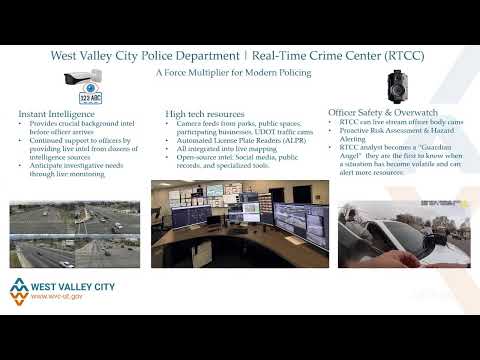
Presenters said the center aggregates live park and traffic cameras, license-plate reader inputs and open-source information so intelligence analysts can assist officers while they are still on scene. Staff said the capability has shortened investigative timelines in some cases and improved officer safety: in one recent example an analyst monitoring a body-worn camera called for help when an officer was attacked, enabling a timely backup response.
The center launched in January 2025 and reached fuller operational status by March, but staff said current coverage is not yet 24/7; the operating schedule cited is Monday through Saturday, roughly mid-afternoon to midnight. Analysts prioritize high-priority, in-progress calls and otherwise triage follow-up work where they can add the most value.
Council members raised retention and privacy questions about camera feeds and license-plate readers. Staff said retention periods are set by the system owners (many feeds are third-party) and that access usually requires agreements; they also said a proposed program to let businesses or residents opt in to share footage is on hold pending legislation and policy review. Staff emphasized that license-plate-reader use is typically targeted to specific investigative needs rather than broad, untargeted searches.
No vote or policy change occurred at the retreat; staff offered to provide additional scheduling and retention details later.