Lifetime Citizen Portal Access — AI Briefings, Alerts & Unlimited Follows
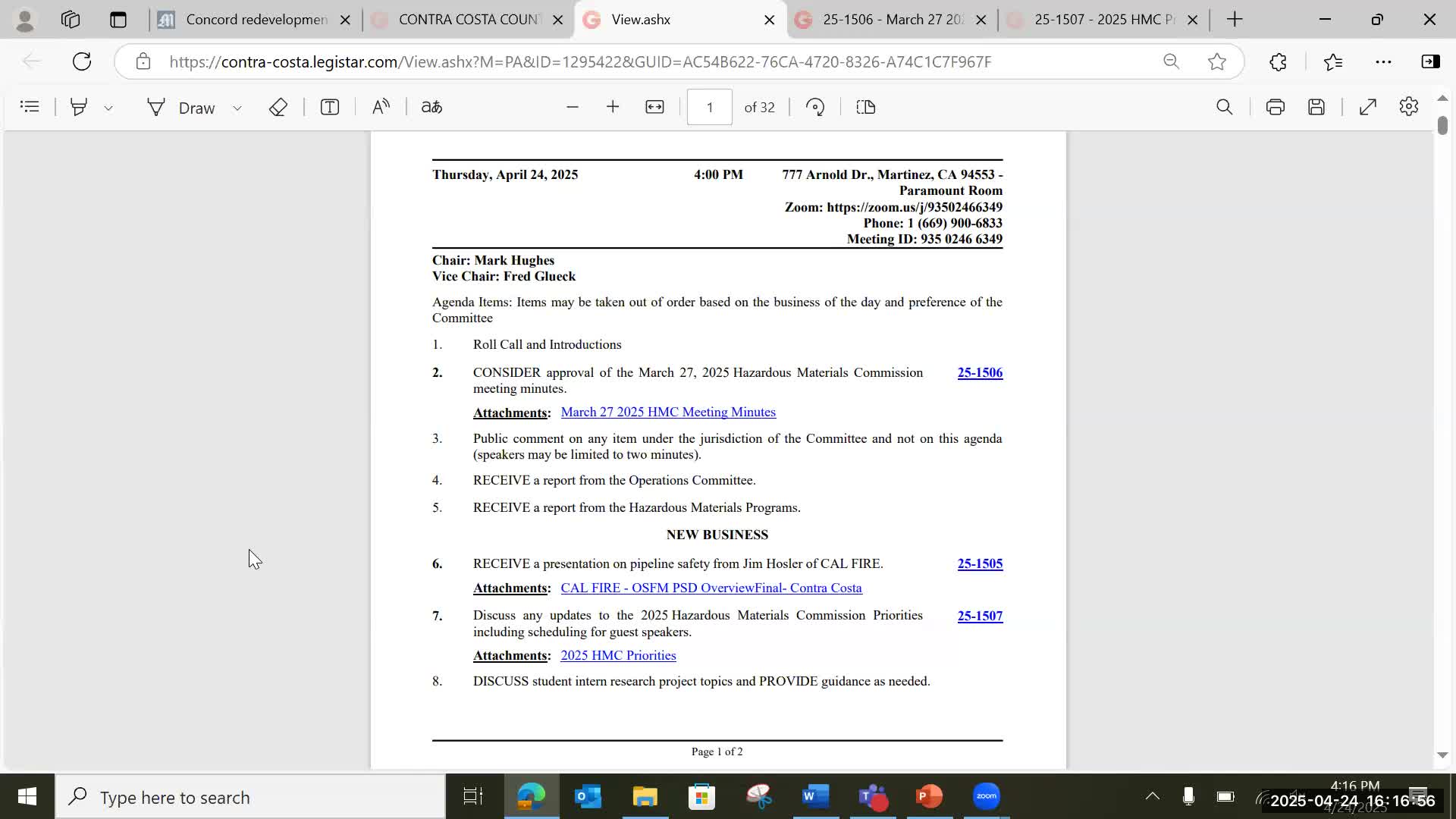
CAL FIRE outlines pipeline safety authority, mapping and foam rules in presentation to Contra Costa HazMat Commission
Loading...
Summary
Jim Hossler of CAL FIRE briefed the Contra Costa Hazardous Materials Commission on the state's pipeline safety and CUPA programs, saying the office oversees about 5,500 miles of intrastate hazardous liquid pipelines, operates a mapping system accurate to roughly 150 feet, and is implementing restrictions on PFAS foams under SB 1044.
Jim Hossler, assistant deputy director and chief of pipeline safety and the CUPA program at the California Office of the State Fire Marshal, told the Contra Costa County Hazardous Materials Commission that his office regulates the safety of intrastate hazardous liquid pipelines and audits local CUPA (Certified Unified Program Agency) implementation across cities and counties.
Hossler said the office is responsible for inspections, operator qualification checks, integrity management and emergency‑response plans for roughly "approximately 5,500 miles" of intrastate hazardous liquid pipelines in California. "We respond 24 hours a day, 365 days a year," he said, describing the state's notification process that routes significant pipeline or train‑derailment incidents through the Office of Emergency Services and, when large enough, to federal centers.
He described the agency's mapping system, saying operators report pipeline locations to the office and that the internal maps are "accurate to within a 150 feet or less." Hossler noted the office fields an estimated 1,300 public records and mapping requests a year and that detailed public distribution of pipeline maps is constrained by federal homeland‑security rules.
The presentation reviewed historical incidents that shaped state regulation, including the Gale Avenue fire and the 2004 Walnut Creek event, and the 2015 Refugio oil spill, which Hossler said prompted program expansion. He described how authority is divided when material is still in a production state (handled by other agencies such as CalGEM/state lands) versus when it is processed for transportation, which places it under the state fire marshal's pipeline program.
On firefighting foams and PFAS, Hossler summarized recent state action, citing SB 1044 and the Health and Safety Code restrictions on fluorinated foams. He said the law limits use of PFAS‑added foams outside narrowly defined facilities (refineries, large tank farms) and establishes a phase‑out path; "the new foams do work," Hossler said, "but they're a little bit different" and often require more material and different application techniques.
Commissioners raised local questions about whether CAL FIRE had been consulted on a Contra Costa ordinance amendment adding tank farms to an ISO regulation; Hossler said the state office had not been consulted but could be if asked. He also told the commission the state office does not directly enforce environmental remediation for foam contamination but will accept reports and can refer matters to the county or Department of Justice for legal action.
Hossler said advances in inspection technology ("smart pigs" and ultrasonic tools) are increasing detection capabilities and that the office aims to raise the statewide inspection and integrity standard. He closed by pointing commissioners to the office's website and stated materials and slides are already on file with the commission.
The presentation ran from an announced start to a formal close; commissioners followed with several technical and jurisdictional questions and thanked Hossler for the briefing. The commission asked staff to keep slides and reference links available for future discussion.
The state presenter's remarks, the commission's questions about local ordinance language, and the resident comments about foam contamination are expected to inform local outreach and follow‑up with county legal staff and regulatory contacts.