Get Full Government Meeting Transcripts, Videos, & Alerts Forever!
Get email alerts on the Efuels topic
No spam. Unsubscribe anytime.
California firm outlines CO2-to-fuel technology, Moses Lake demonstration and billion-liter offtake with airline group
Summary
A California-based carbon-transformation company described its CO2 electrolysis process for e-fuels, a demonstration plant in Moses Lake, Washington, and commercial offtake deals including a major contract with International Airlines Group and an Alaska Airlines first flight. Presenters said the Moses Lake plant will use municipal water and net-new renewable electricity and begin operations before scaling to larger facilities.
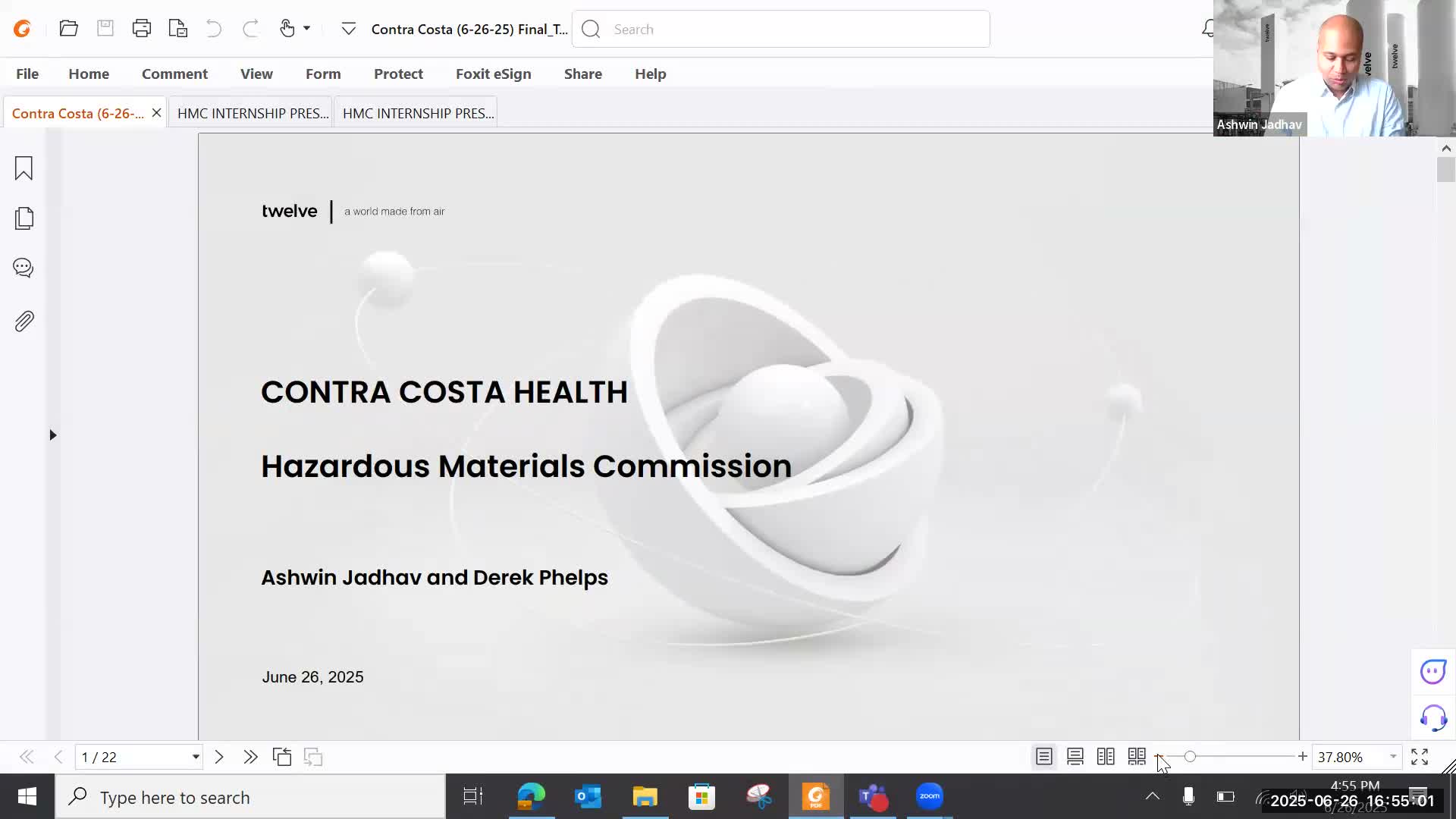
A California-based carbon-transformation company told the Hazardous Materials Commission it is developing technology to make fuels, chemicals and plastics from carbon dioxide and renewable electricity and is moving to demonstration-scale production.
Presenters Ashwin Jadav and Derek Belps described a modular CO2-electrolysis process that converts CO2 to intermediary products using membrane "leaves" stacked into "OPUS" units and grouped into full-scale plants. Derek said the company is building a demonstration plant in Moses Lake, Washington, and has commercial agreements for offtake, including a planned demonstration flight with Alaska Airlines and a large contract with International Airlines Group.
Derek said the agreement with International Airlines Group is a 14-year contract that he characterized as about 1,000,000,000 liters, noting that these offtake deals demonstrate commercial confidence in the technology. He and Jadav said the Moses Lake plant will source municipal water locally, return treated water to the municipality (noting they add glycerine to avoid ecological impacts of very clean process water), and secure new renewable electricity supplies (including hydropower at Moses Lake) to ensure the product is driven by green energy.
On blending and certification, Ashwin said the first operational step will use conservative blending ratios for aircraft trials, starting around 20% e-jet and ramping toward the FAA-mandated 50% blend limit as the technology demonstrates performance. He said the product at the tail end of the process is —drop-in certified— (Fischer-Tropsch synthesis) and that blended products conform to established aviation fuel specifications.
Costs and policy: presenters said federal and state incentives and policy signals bring roughly $4'$6 per gallon in revenue support for e-fuels in the project's financial modeling, and they described plans to scale manufacturing of CO2 electrolyzer components in California while siting production facilities in regions with lower electricity costs.
Next steps: the company will operate the Moses Lake demonstration modules, produce initial gallons for blending and plan a first flight with Alaska Airlines early next year; staff and commissioners asked about local resource impacts and certification, and the presenters said they will return with progress updates as the demonstration proceeds.