Get Full Government Meeting Transcripts, Videos, & Alerts Forever!
Get email alerts on the Hazardous Waste Plan topic
No spam. Unsubscribe anytime.
DTSC outlines draft statewide hazardous‑waste plan, flags battery, permitting and disposal challenges
Summary
State Department of Toxic Substances Control staff presented a draft California Hazardous Waste Management Plan, emphasizing environmental‑justice goals, community‑considerate cleanups and targeted work on lithium‑ion batteries and 'incinerable' waste; comments on the draft are due Aug. 4, with a Board vote expected in November.
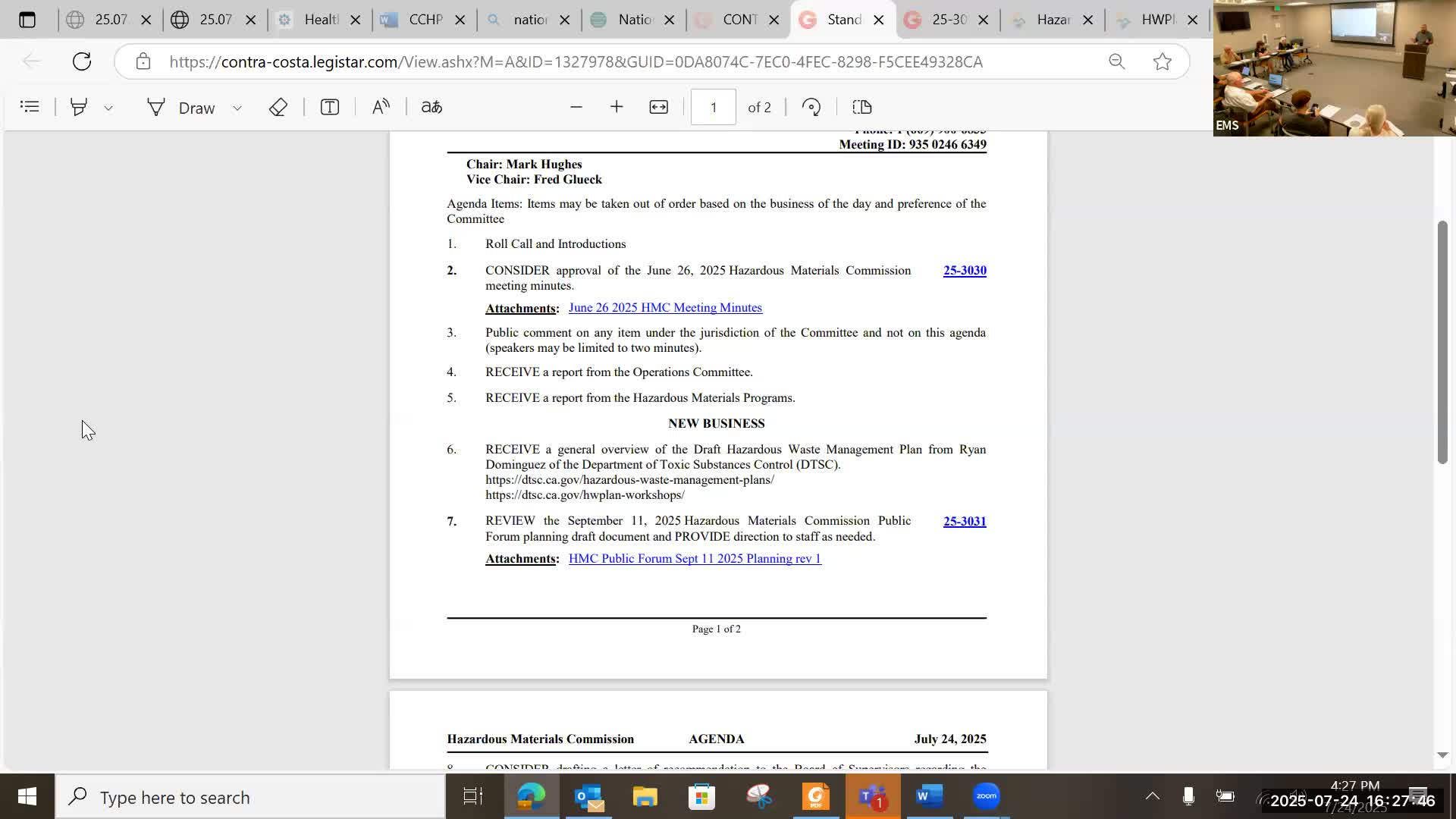
Ryan Dominguez of the California Department of Toxic Substances Control told the Contra Costa County Hazardous Materials Commission that the state’s draft Hazardous Waste Management Plan responds to a 2021 legislative requirement and will guide hazardous‑waste policy going forward. "The plan is due 2025," he said, describing the document as an iterative framework of 10 goals and roughly 37 recommendations drawn from a 2023 technical report and extensive public workshops.
Dominguez said the report shows hazardous‑waste generation has fallen "about 40% in the state, since the year 2000," even as the number of generators has risen to about 100,000. He flagged two near‑term priorities: lithium‑ion batteries and what the plan terms combustible or "incinerable" waste. On batteries, Dominguez said a major problem is tracking and managing them: they are commonly grouped as "universal waste," so they do not appear on the hazardous‑waste manifests that regulators use to quantify flows. "It's difficult to quantify how many may become a waste," he said, complicating planning for recycling capacity.
Permitting bottlenecks are a central obstacle, Dominguez told the commission. He said there has not been a new hazardous‑waste facility permit issued since 1986 and that the number of permitted facilities has fallen from more than 400 in the 1980s to fewer than 75 today. He estimated a DTSC review for a full facility permit takes about two years and costs roughly $250,000, not counting CEQA and local land‑use steps.
On incinerable waste, Dominguez said California currently lacks commercial hazardous‑waste combustors; generators requiring that form of disposal send waste to facilities in other states, which has created capacity and compliance pressures. "We feel some effects of that because there's no capacity in the state to manage that waste," he said, naming Nebraska, Utah and Texas among destinations mentioned in the presentation.
Dominguez highlighted components of the plan aimed at protecting communities: the concept of "community‑considerate cleanups" to reduce local impacts of cleanup activity, improved data collection and revisiting lower‑tier permit allowances to enable more recycling and treatment technologies. He also said the board receiving the draft has held hearings in multiple cities and that the public comment period and schedule are moving quickly: comments on the draft plan were noted as due on August 4; a revised draft was expected for September and a virtual workshop in October, with the Board vote scheduled for November.
Commissioners pressed on international models for battery circularity, emergency steps to address accumulating batteries, and whether statutory changes will be required to ease permitting or adopt federal exclusions. Dominguez said DTSC implements regulations and can work with legislative sponsors on statutory changes but does not itself make law. He also confirmed DTSC evaluates remediation pilots — including phytoremediation and mycoremediation — where project‑specific conditions make them appropriate.
The presentation closed with a call for feedback: Dominguez asked commissioners and county staff to submit comments before the August 4 deadline and offered to follow up with DTSC program contacts for members interested in technical details.