
Council approves liquor‑license renewals for two downtown hotels after extended review and safety debate
Get AI-powered insights, summaries, and transcripts
Subscribe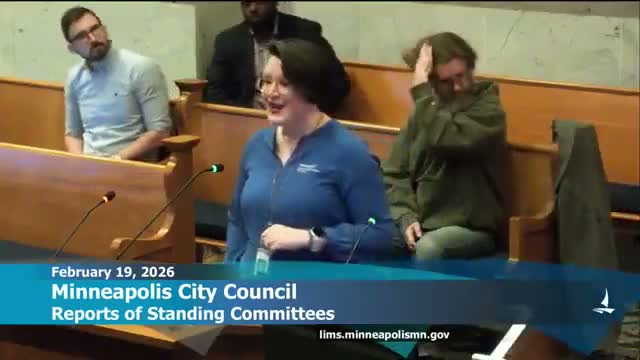
Summary
After an extended CPED investigation and hours of council discussion about worker safety and alleged ICE activity, Minneapolis City Council voted to renew on‑sale liquor licenses for the Canopy by Hilton (Mill District) and the Depot (Renaissance) Hotel, with CPED concluding “there is not good cause to deny” the renewals; final roll was recorded 8–5 in favor.
Minneapolis — The City Council voted Feb. 19 to approve renewal of on‑sale liquor licenses for two downtown hotels — the Canopy by Hilton Minneapolis Mill District and the Depot Minneapolis (a Renaissance hotel) — after a staff review found no statutory basis to deny the renewals and recommended approving them without conditions.
Amy Lingo, manager for licenses and consumer services in the Community Planning and Economic Development Department (CPED), presented the results of an extended investigation into the two hotel renewals. Lingo said both properties had paid renewals and had no business‑licensing enforcement history that would justify denial under the city’s liquor code. “In reviewing the concerns and feedback as well as relevant Minneapolis liquor code and Minnesota liquor statutes, there is not good cause to deny these renewals,” she said, and recommended the licenses be approved “for renewal without conditions.”
Council members pressed CPED over public testimony in recent days from hotel workers and community members alleging worker fear, reports of weapons or unrest near hotel rooms and the presence of federal immigration agents. Council Member Chowdhury said she had heard testimony that some workers were too afraid to testify in person and asked whether CPED had followed up with those workers; Lingo said staff had discussed mitigation measures with hotel management but emphasized that many of the worker concerns — including alleged weapons found in private hotel rooms — relate to hotel licensing and occupancy, not the on‑sale liquor license. "That doesn't really relate to the liquor license per se," Lingo told the council.
Other council members framed a broader public‑safety and political question. Vice President Osmond — who moved approval of the item — said the events in the hotels had been “unsafe” and noted the council’s desire to hold businesses accountable for worker safety while also following the law. Council Member Palmisano urged adherence to due‑process standards and warned against conflating broader hotel‑safety allegations with the standard for denying a liquor license.
The council debated several options, including whether to place conditions on the licenses. After a roll call and one member’s request to change their recorded vote, the council recorded the final outcome as 8 ayes and 5 nays and approved the renewals. Several members said they will continue to explore other avenues — including hotel licensing and employment protections — to address worker safety concerns that fall outside the liquor‑license framework.
CPED said business‑licensing staff will continue to monitor complaints and that hotel licenses (distinct from liquor licenses) are reviewed on a November schedule. The action taken Feb. 19 affirms the liquor‑license renewals; it does not close other oversight pathways for hotel operations or worker‑safety allegations.
Vote: After staff presentation and debate, council approved the two liquor‑license renewals (final recorded vote: 8 ayes, 5 nays).