Get Full Government Meeting Transcripts, Videos, & Alerts Forever!
Get email alerts on the Sustainable Finance topic
No spam. Unsubscribe anytime.
Commission discusses "Institute of Sustainable Finance" concept; public raises procurement and conflict concerns
Summary
Commissioners introduced a concept for an Institute of Sustainable Finance (ISF) to explore long-term financing tools for county behavioral health; public commenters urged guardrails, transparency and raised an allegation that individuals tied to private venture interests are promoting the idea.
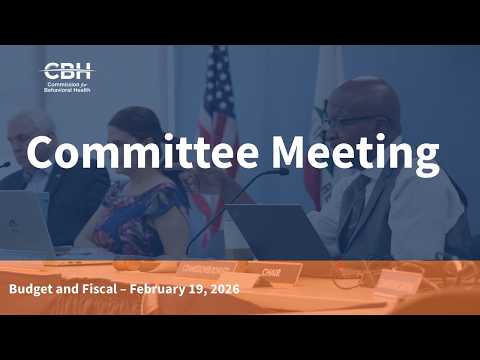
The Budget and Fiscal Advisory Committee discussed a concept for an Institute of Sustainable Finance (ISF) intended to analyze funding volatility, model return on investment for behavioral health, and design pilot blended-finance or bond-based approaches to expand long-term funding.
Chair Al Rowlett and Commissioner Steve Carnivale framed the discussion as an early concept rather than a formal proposal: any proposal would need to be developed and then vetted through the commission's committee process (Program Advisory Committee and Client/Family/Community inclusion committee, then BFA, then full commission) before any funding or procurement would be considered. "Again, this is a concept," Rowlett said, underscoring that "there are no dollars allocated or no proposed encumbrance on any fund" at this stage.
Commissioner Carnivale described the ISF as a possible mechanism to "map and quantify funding volatility" and to test financing tools—bonds, public'2private partnerships, blended finance and credit-enhancement strategies—that might increase capacity for clinics, crisis services and workforce expansion. He said the objective would be to move from one-time grants to structured, scalable financing backed by evidence and measurement.
Public commenters and several commissioners urged caution. Community speakers asked for concrete guardrails, plain-language reporting and competitive procurement processes before the commission pursued private financing structures. In online public comment, Joel alleged that "the individual who has pushed this scheme is a founding partner of an early stage venture firm" and suggested a potential conflict of interest tied to a former executive director; he asked commissioners to be skeptical. The chair and Commissioner Carnivale responded that concerns would be noted and that the concept was not intended to create a for-profit entity. "This is not to create a for profit entity or an entity that anybody makes any money on," Carnivale said.
Speakers also asked how the ISF would be funded if it moved beyond concept to proposal. Commissioners and staff said funding sources were not yet determined: a future proposal could be submitted for innovation funding or other sources, but that determination would follow the committee vetting process and legal review.
Commissioners requested that any future proposal clearly define governance gates, procurement safeguards, public-interest protections, disclosure and recusal standards, and plain-language reporting so community stakeholders can meaningfully engage. The committee did not vote on the concept; Chair Rowlett said the BFA would reconvene to continue discussion in early April or May.
Public input and follow-up materials are expected to inform the development of any formal proposal.