
EDA webinar walks applicants through Path 3 (industry transformation) submissions, deadlines and match rules
Get AI-powered insights, summaries, and transcripts
Sign Up Free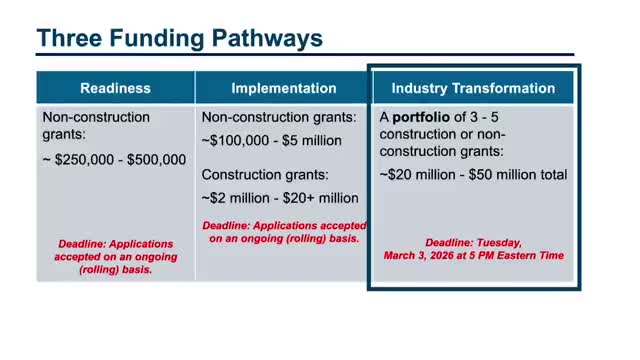
Summary
The Economic Development Administration reminded Path 3 applicants that portfolios should include three to five linked projects totaling roughly $20–$50 million, reiterated a March 3, 5 p.m. ET deadline, and clarified Edge upload rules and match vs. commitment requirements, including that contractors cannot both provide match and receive federal funds.
The Economic Development Administration held a webinar for FY25 Disaster Supplemental applicants focused on the Industry Transformation (Path 3) competition, walking participants through Edge application setup, required documents and frequently seen errors.
Justin, an EDA presenter, opened the session and said the program seeks portfolios of three to five interconnected projects worth about $20,000,000 to $50,000,000 and reminded applicants that "the deadline is coming very quickly, Tuesday, March 3, at 5 p.m. Eastern Standard Time." Amanda Costi, who led the detailed portion of the webinar, told applicants to use the NOFO "as your North Star" and to follow the summary table on page 35 for required materials.
Why it matters: applicants for the Path 3 industry transformation track must assemble coalition‑level documentation (a 10‑page overarching narrative, match calculations and commitment letters or ED‑900B forms) and upload those materials in Edge attached to one component project because Edge does not provide a separate coalition application record. "There is not a separate overarching application in Edge," Amanda said, adding that staff will link component applications on the back end using the association feature.
What to submit and where: Amanda summarized coalition‑wide requirements and the documents required per component project. Non‑construction components require the SF‑424A and a detailed budget narrative; construction components require the SF‑424C, the ED‑900C (including a preliminary engineering report) or ED‑900D for design‑only work, and environmental documentation. Applicants must attach match letters to the respective component projects; commitments (evidence of outside leverage such as employer hiring pledges or scholarship funding) may be filed as ED‑900B or as signed letters.
Match rules and common pitfalls: Amanda repeatedly warned that match and commitments are distinct. Match is part of the project scope and budget; commitments are outside the budget and are used to show broader coalition support. She gave a portfolio example: a $38,400,000 federal request at 20% match requires $9,600,000 in match. She also emphasized procurement and eligibility limits, including that "a contractor cannot provide match and receive federal share" — meaning an entity supplying match funds cannot also be paid with the federal award for the same work.
Edge and submission tips: Edge accepts one file per upload field; applicants should combine multiple documents into a single PDF or a zip file. Edge "doesn't like files over 25 megabytes," Amanda said; for larger renderings applicants should contact the Edge help desk. She stressed setting up an application team early and making sure an authorized representative (a signatory with authority in Edge) is assigned because "only the authorized representative can submit the funding request." Applicants should confirm organization profile data in Edge, choose clear project titles (which are not easily changed), and verify staffing plans and budget totals to avoid reviewer confusion.
Q&A takeaways: In response to attendee questions, EDA staff clarified that: (1) the overarching narrative only needs to be uploaded once to any component project and staff will locate it; (2) match may be tracked across the portfolio rather than project‑by‑project; (3) match letters must include exact dollar amounts, an authorized representative's signature, and a statement that funds are unencumbered and committed; and (4) if a single letter contains both match and commitments, applicants should upload that document multiple times and clearly label which portion is match and which is commitment.
Next steps: Webinar recordings, NOFO materials and form templates will be posted; applicants with IT issues should contact the Edge help desk and form questions should go to local Economic Development Representatives. The application must be fully submitted in Edge by March 3 at 5 p.m. Eastern to be considered.
The webinar closed with a final reminder of the deadline and encouragement to double‑check budgets and authorized representatives before final submission.