Get Full Government Meeting Transcripts, Videos, & Alerts Forever!
Get email alerts on the Community Solar Permits topic
No spam. Unsubscribe anytime.
Iroquois County panel recommends approval of solar variances with strict drainage and safety conditions
Summary
A county zoning panel recommended approval of variances and conditional‑use permits for multiple community solar projects but attached about 20 conditions after public testimony raising concerns about subsurface drainage tile mapping, GPR survey limits, battery safety and tax benefit estimates.
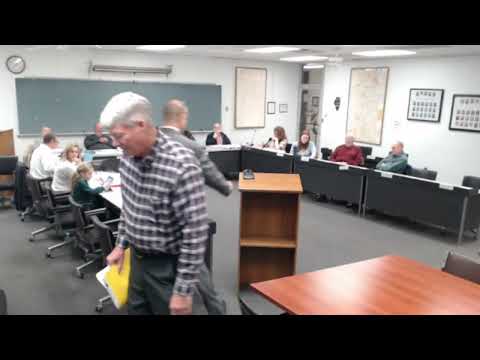
An Iroquois County hearing on Oct. 29, 2025, ended with the zoning advisory panel recommending approval of variances and conditional‑use permits for a set of community solar projects, subject to roughly 20 conditions aimed at protecting drainage, requiring vegetative screening and ensuring emergency and decommissioning safeguards.
The recommendation followed hours of testimony from adjacent landowners, project representatives and county staff. Landowner Rodney Gustafson raised the hearing’s most sustained concerns, saying the developer’s ground‑penetrating radar (GPR) survey had limited penetration and may have missed existing subsurface drain tile. “The GPR acquisition was completed on 10/29/2025,” Gustafson said, and he told the panel the data showed poor penetration—“less than 2 feet”—in places and that Westwood (the surveyor) warned it could not warrant the presence or absence of tile beyond the instrument’s depth or in unanalyzed areas.
Gustafson also pointed to owner‑supplied maps and a 2020 digital image from the drain‑tile contractor, arguing some lines outside the project boundary reflect privately installed tile that could be affected by pile placement. He warned that damage to those connections could cause basement flooding at nearby rural homes. Gustafson quoted posted tax‑benefit figures for the project—“US Solar will pay per year estimated taxes on this project of 26,000 to $35,000…nearly $600,000 over the next 20 years”—but said the distribution and longevity of those revenues were uncertain.
Representatives for the developer said the projects are currently in an identification phase and that the company uses GPR plus landowner documents to map tile. The developer’s witness, who identified themselves as a stormwater engineer, said the design approach is to “identify, design around the tile, and if we can’t design around it, reroute it” during final engineering. The company also described battery safety measures, saying battery cabinets would be temperature‑controlled, include internal suppression and remote shutoffs and that a staffed operations desk would be available 24/7 to coordinate incidents with emergency services.
Board members and staff proposed and discussed a package of conditions intended to address the concerns raised. Key suggested requirements included: additional coordination with adjacent landowners to verify tile locations; retention of a county‑retained third‑party drainage consultant to help confirm subsurface tile and review mitigation; submission and county review of a year‑round vegetative screening/landscape plan; detailed fire and emergency response plans for battery storage and proof of insurance and financial assurances, including decommissioning and reimbursement terms.
During deliberations, staff said the package consisted of about 20 conditions spanning landscape screening, drainage protections, preconstruction work agreements, decommissioning and financial assurances, and specific battery‑storage provisions. Speaker 3 and other panel members emphasized that third‑party expertise in agricultural drainage would be needed because farm drainage systems and century‑old tile networks vary in construction and can be difficult to map from GPR alone.
After discussion, a motion to forward the variance/conditional‑use permit to the county board with the recommended conditions and to incorporate additional testimony was moved and seconded; several members voiced assent and staff stated the recommendation would be approval with the listed conditions. The panel’s action is a recommendation to the county board; it is not a final building permit or construction authorization. Developers will still need to obtain building permits and satisfy the preconstruction conditions, including any additional tile probing or remediation required by the county prior to construction.
The hearing also included exchanges about notice and project addressing (the developer said an E‑911 address will be provided during permitting), and questions about long‑term tax estimates and lease terms (the application referenced a 20‑year initial term with five‑year extensions allowed in the lease). The developer said it had not yet deposited for specific equipment but was planning to use iron‑phosphate batteries (LG) and domestic panels when contracts are finalized.
Next steps: the zoning panel’s recommendation will be forwarded to the Iroquois County board for its consideration. If the board approves the variances and conditional‑use permits, developers must still satisfy the preconstruction conditions and obtain building permits before beginning work.