Get Full Government Meeting Transcripts, Videos, & Alerts Forever!
Get email alerts on the Code Enforcement Roundup topic
No spam. Unsubscribe anytime.
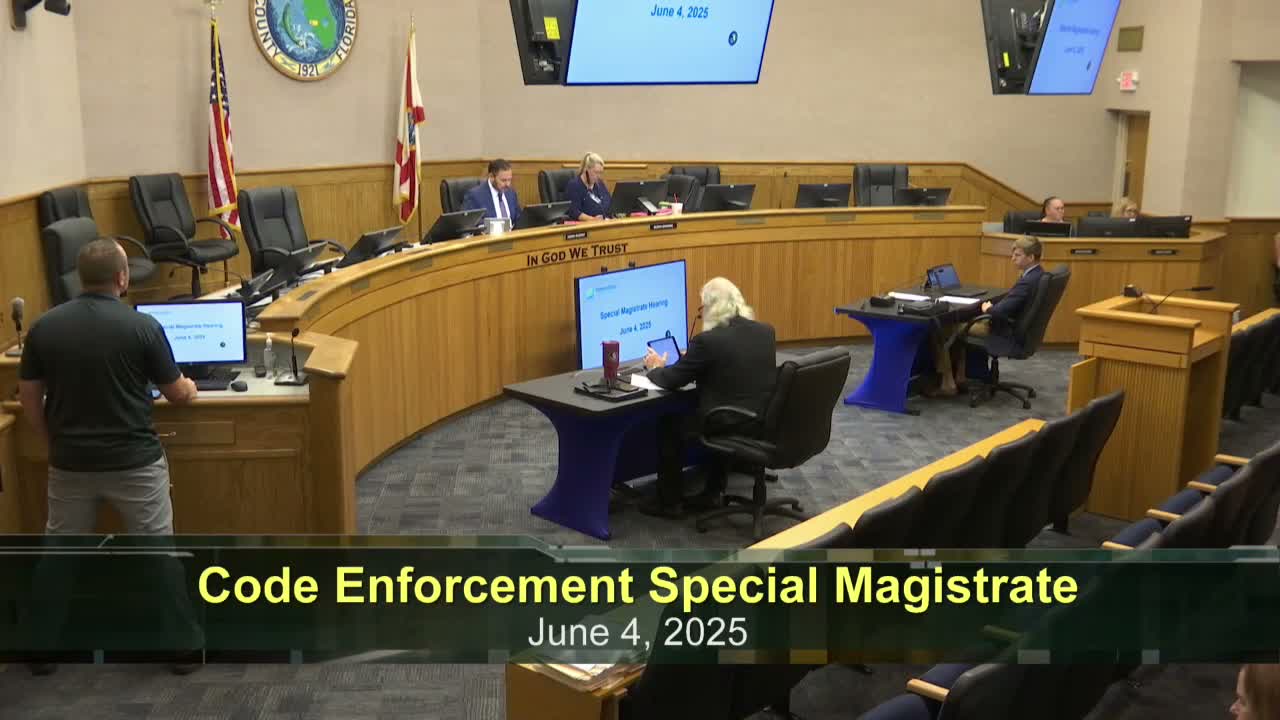
Charlotte County magistrate hears dozens of code cases; fines, continuances, and 120‑day compliance windows ordered
Summary
The Charlotte County Code Enforcement Special Magistrate on June 4 reviewed dozens of properties damaged or altered after Hurricane Ian and for other code violations. The hearing produced a mix of one‑day fines (commonly $70), long‑term affidavits and several 30–180 day continuances to allow permit work or demolition; one property faces a $4,520 90‑day fine cycle.
The Charlotte County Code Enforcement Special Magistrate on June 4 heard a large docket of cases ranging from high‑grass and junk‑like conditions to disputed zoning uses and unpermitted construction. The hearing officer opened by explaining that the county bears the burden to prove a violation and warned respondents, "Don't testify against yourself," before swearing in witnesses.
County officers presented inspections, photographs and permit histories across the docket. Common outcomes included entry of one‑day affidavits of noncompliance — typically a nominal $70 charge to trigger monitoring — and longer affidavit cycles that escalate to higher fines if noncompliance continues. For repeat or more serious matters officers said later fines would reach rates such as $50 per day for continuing violations and, in some multi‑cycle matters, $4,520 (a fifth ANC) where $50/day accrues over 90‑day periods.
Several owners told the magistrate they were working under post‑storm repair timelines or insurance delays. For one storm‑damaged property whose owner said a lawsuit against the insurer had been settled, the magistrate entered a $70 affidavit but agreed not to return the case to the docket and allowed 120 days so the bank and homeowner could coordinate demolition and clean‑up.
Other orders gave property owners between 30 and 180 days to pull permits, finish repairs, or remove items. In multiple cases the magistrate admonished owners that pulling permits and keeping active permit records were key to stopping fines: "Once a permit's pulled, then the case as long as you've cleaned up the outside, the case will hold while the work is being done," the hearing officer said.
For repeat violations and certain hazards the magistrate imposed cease‑and‑desist orders (typically two years) and warned of county abatement at the owner's expense if compliance was not achieved.
What happens next: officers were directed to re‑inspect properties according to the timeframes set in each order. Owners who believe they have additional evidence (e.g., proof of insurance payouts, permit submittals, or contractors’ work) were advised to provide documents to the assigned code officer so the magistrate or staff can reevaluate before higher fines accrue.