
UDOT reports lower year‑end fatality rate for 2025 but notes vulnerable users remain a large share
Get AI-powered insights, summaries, and transcripts
Subscribe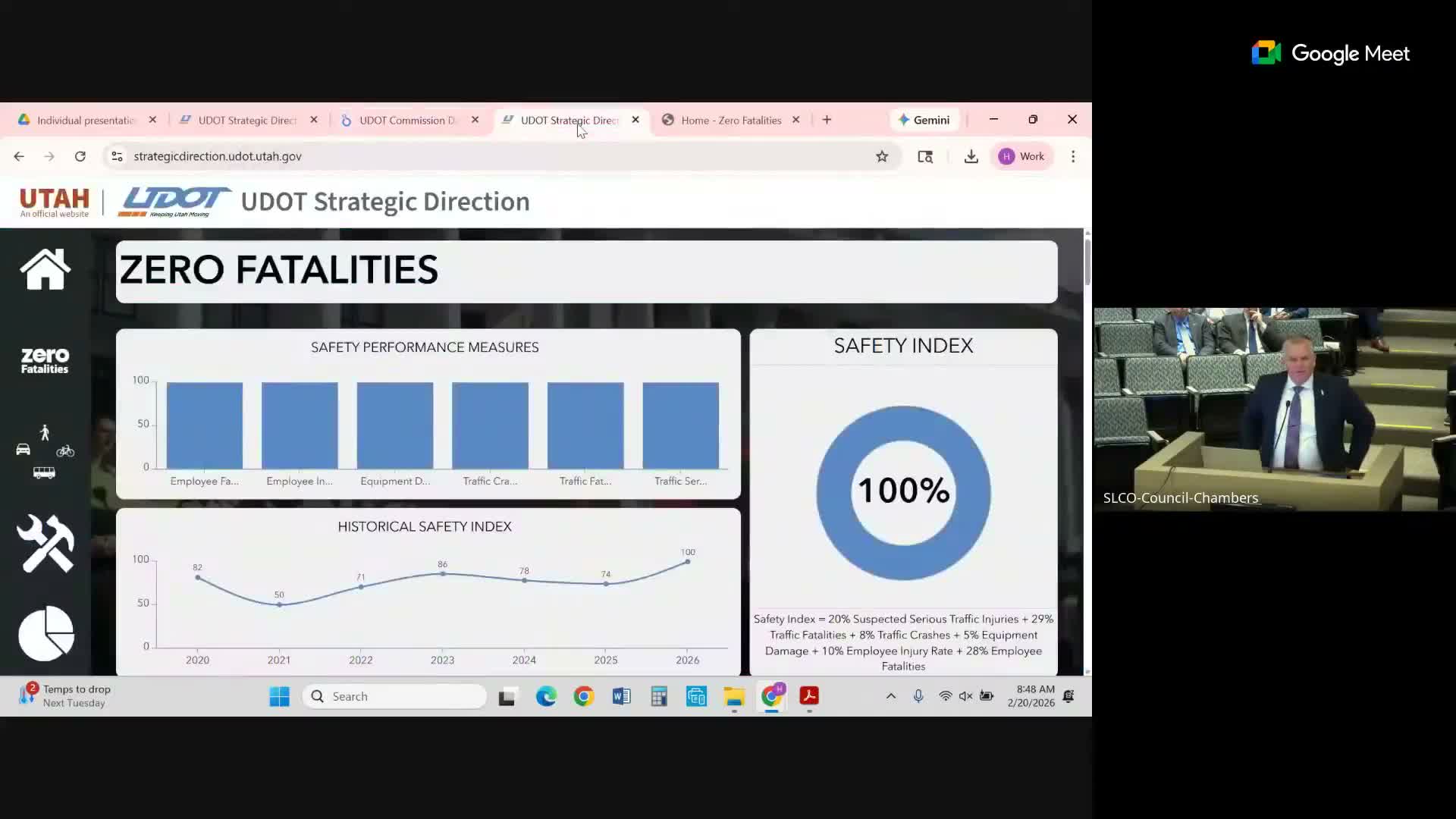
Summary
UDOT staff told the Transportation Commission the statewide fatality rate dropped from 0.73 in 2025 to an early 2026 rate of about 0.55; officials warned that vulnerable road users (pedestrians, bicyclists, motorcyclists) made up a large share of fatalities and that injury figures for 2025/2026 remain preliminary.
Troy Peterson, UDOT’s operations director, told the Transportation Commission that the department’s safety metrics show improvement in the 2025 fatality rate but continuing concern for vulnerable road users.
Peterson said the reported fatality rate for 2025 closed at 0.73 and the current 2026 rate sits about 0.55. He reported roughly 270 fatalities in 2025 — about 5% lower than 2024 — and noted that, so far in 2026, vulnerable users account for about 43% of fatalities, which Peterson said amounts to approximately 10 pedestrian fatalities to date. He cautioned that many injury and crash statistics are preliminary early in the year.
Peterson also flagged a significant rise in suspected serious traffic injuries in 2025 (more than 2,000 suspected serious injuries), which exceeded the department’s reduction target by about 21%; he said UDOT will analyze the data further and present a fuller review next month. He emphasized UDOT’s ‘‘0 Fatalities’’ campaign and the department’s multi‑pronged approach — engineering, enforcement, emergency response and education — and urged basic safety behaviors: wear seat belts, drive sober and stay alert.
Commissioners asked about specific countermeasures for wrong‑way driving and education programs for younger drivers. Peterson said UDOT is testing technologies to speed wrong‑way notifications to traffic operations centers and described outreach in schools as part of the department’s strategy.
What’s next: UDOT plans a more comprehensive report on 2025 crash data in a later meeting and staff will continue evaluating technologies and outreach programs to reduce wrong‑way driving and vulnerable‑user fatalities.