
Residents press Nye County for clarity on 'zombie lots,' water access and RV residency rules
Get AI-powered insights, summaries, and transcripts
Subscribe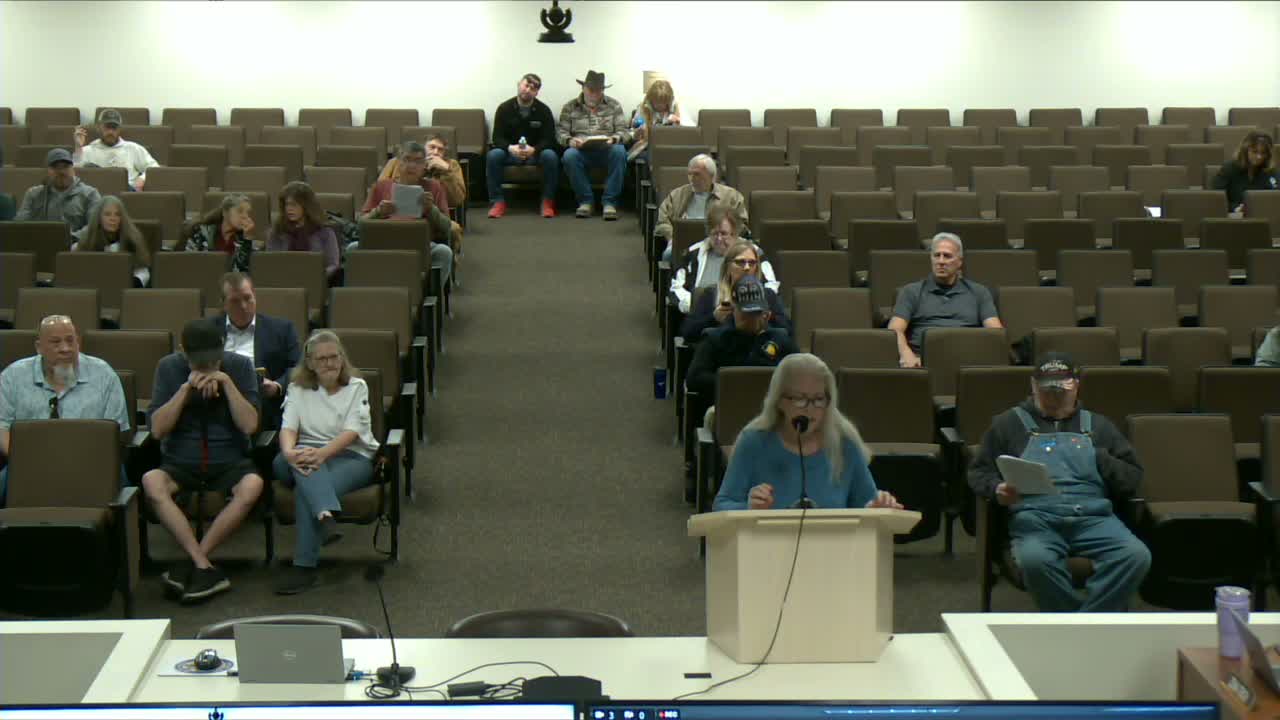
Summary
Dozens of residents urged Nye County to clarify who can make vacant parcels usable, pushed for alternatives such as tiny-home communities and amendments to RV residency rules, and criticized enforcement inconsistency. Commenters repeatedly asked the board to identify the single agency with authority to resolve the 'zombie lots' governance gap.
Public comment at the Feb. 18 Nye County meeting was dominated by residents seeking clearer pathways to make so-called “zombie lots” buildable and to allow residents to occupy deeded lots with safe utility connections. Multiple callers — including Patricia Robb, Carol Milke and Molly Valdez — said long-time landowners cannot build because of zoning, water-tariff limits and infrastructure gaps, and they asked the county to identify which agency or process has authority to resolve the problem.
"Who specifically has the authority to make these lots usable? Name the agency, name the department, name the process," Molly Valdez said, describing a cycle of referrals among Great Basin Water Company, the county planning office, the water district and state agencies.
Homeowners and advocates proposed practical fixes: allow permit-based permanent RV residency on deeded 1‑acre parcels with verified septic and well connections (Brett Fish), consider tiny‑home communities for seniors and first-time buyers (Beth Borysiewicz), and create a transparent committee schedule so owners can participate in water-district planning. Commenters also urged the county to permit community wells and to consider pilot alternative wastewater systems.
Commissioners and staff responded that the water-district committee is evaluating options, that state statutes limit certain wells on small lots, and that there are administrative pathways (code amendment applications through planning) for proposing rule changes. Several speakers asked the board to be explicit on the record about which agency holds the authority to act; some called the problem a “governance gap” within local control.
The meeting produced no immediate policy change on the zombie-lot issue, but commissioners acknowledged the volume of concerns and the need to coordinate county planning, the water district and other stakeholders to create clearer paths for property owners.