
Council committee approves revised transportation-sales-tax allocations, sends plan for 30-day public comment
Get AI-powered insights, summaries, and transcripts
Subscribe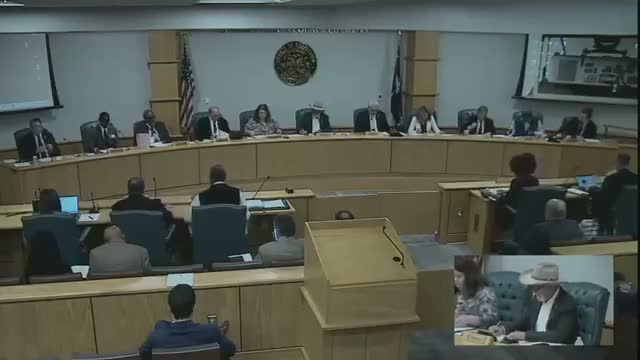
Summary
A council committee vote (5–4) approved a motion reallocating $75 million from a reduced battery-extension project into three $25 million priorities — North Charleston projects, Haygood Avenue improvements and transit implementation for a downtown route study — and directed staff to begin at least 30 days of public outreach. Public Works said outreach will include in-person meetings, an online survey and scientific polling.
Charleston County’s transportation-sales-tax special committee on an administrative motion approved reallocating $75 million freed from a scaled-back battery-extension project into three $25 million priorities and sent the revised draft to the public for at least 30 days of comment.
The motion — approved 5–4 on a roll call vote — moved $25 million to City of North Charleston priorities, $25 million to transit designated for implementation of a downtown route study, and $25 million to the Haygood Avenue improvement plan. The motion included offsets by reducing some intersection and pavement-management allocations and by trimming bike-and-ped funding while increasing the greenbelt allocation, and a later clerical correction clarified the net change to transit funding.
Why it matters: The vote reshapes how the county’s proposed transportation sales tax would spend a large block of discretionary funding, affecting roadway projects, transit service and conservation money. Opponents said the changes risk reducing money for road maintenance and local congestion relief; supporters called the package a compromise intended to spread benefits across the county.
Councilmember Wurman, the motion’s mover, described the package as a compromise intended to “address countywide needs” by freeing $75 million from the battery extension and directing it to Haygood Avenue, North Charleston projects and a modest increase to transit. He said the mix was intended to bring more members together to support the overall plan.
Councilmember Brandon Moody questioned the reductions to pavement and intersection programs and ran through arithmetic to argue that a large share of the total TST pie would still be spent on roads. Moody said many constituents, “the average Joe in my district,” prioritize direct road investments and would expect the revenue to address local congestion.
Councilmember Jenny Costa Honeycutt defended several items that opponents labeled non-road spending, saying some amounts described as bike and pedestrian are tied to bridge grants or are debt-service components of bridge projects and therefore functionally related to road infrastructure. “The Seawall is not just a bike path. It is actually protecting the city from flooding,” Honeycutt said, arguing the project addresses public-safety and resilience needs.
Several council members debated Greenbelt funding levels. Councilmember Darby argued the county had exceeded the original Greenbelt acreage goal — citing figures voiced at the meeting — and warned that expanding conservation spending could reduce land available for affordable housing, describing the trade-off as a real affordability concern. Supporters of more Greenbelt funding responded that bargain sales and targeted acquisitions have preserved land, provided public access in many cases, and advanced resilience goals.
After discussion and a correction to the transit accounting (a $25 million number was corrected to $15 million in one line of the motion, producing a net $10 million transit increase), the clerk called the roll. The motion passed with five ayes and four nays.
The committee then voted to send the revised draft out for public comment for no less than 30 days. Eric Adams, the county’s Public Works director, told the committee the outreach plan would mirror the first phase of public engagement: in-person meetings around the county, an online survey and a representative scientific poll of voters.
Next steps: The plan will be published for public comment and refined based on feedback; the committee’s action does not by itself finalize the TST package, which must return to the council and, ultimately, to voters for any referendum as required by county process. The committee adjourned and moved into other scheduled council business.