DNR: two years of data show no immediate population impact from crossbow inclusion; debate focuses on participation and tradition
Loading...
Summary
A Department of Natural Resources report to the Senate Environment, Climate, and Legacy Committee found no evidence in 2023'2024 that allowing crossbows during archery season changed deer or turkey populations; testimony at the Feb. 19 hearing highlighted competing views on hunter recruitment, fairness, and archery tradition.
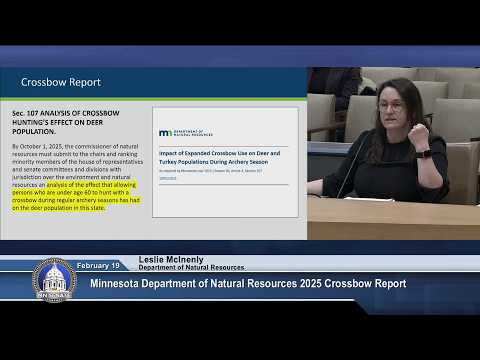
The Department of Natural Resources told the Senate Environment, Climate, and Legacy Committee on Feb. 19 that two years of post-policy data produced "no evidence" the 2023 statutory change allowing crossbow use during archery seasons has altered statewide deer or turkey populations.
Leslie McEnenley, the DNR's wildlife population regulations manager, told the committee the department relied on mandatory harvest records, hunter surveys and other monitoring to compare 2023 and 2024 outcomes. McEnenley said the agency began collecting information in 2023 that distinguishes crossbow from vertical-bow harvests, which limits direct before-and-after comparisons. "Based on those two years, we found no evidence that the statute change expanding crossbow use during the archery season impacted either deer or turkey populations," she said.
The DNR's analysis showed archery harvest increased in 2023 and more substantially in 2024, but McEnenley cautioned that harvest increases were not clearly attributable to crossbows alone and noted calendar effects — including a later firearm season opening in 2024 — that likely affected harvest timing and totals. She said surveys indicate growing crossbow participation among youth, older hunters and women and cited an increase in archery license sales of roughly 6.5 percent.
The findings did not settle a broader policy dispute. Nick Ominude, who identified himself as president of Minnesota Bow Hunters, urged the committee to preserve archery-only tree seasons. "Crossbows represent a clear separation from user-drawn and held equipment," he said, arguing that states that added crossbows saw declines in traditional archery clubs and participation. "A simple shift of archery harvest toward crossbow does not appear to be a management benefit, and it certainly isn't one that outweighs the negative impacts to archery opportunity," Ominude said.
Senator Nathan Wiesenberg, a co-author of the enabling legislation, said he sees no cause for removing crossbow access. "If the argument is there's less participation, why would we take the crossbow season away?" he asked, and added that many constituents support keeping crossbows available to increase access for youth and women.
Darren Lee read a written letter from the Minnesota Deer Hunters Association's executive director, which urged continuation of full crossbow inclusion, asserting crossbows expand access for people with age- or injury-related limitations and support hunter recruitment and license revenue.
Committee members probed the DNR on data limits. McEnenley repeatedly noted that pre-2023 registration data did not record weapon type and said the department modified registration in 2023 to capture that distinction. She recommended continued monitoring, particularly in lottery permit areas and other locales where antlerless harvest pressure could be sensitive to changes in weapon availability.
The committee did not take formal action on the policy during the hearing. Members and witnesses signaled competing priorities: the DNR emphasizing biological monitoring and recruitment effects, opponents warning of cultural and participation losses for traditional archery, and proponents stressing access and inclusion.
The committee is expected to consider legislative options during the session; no vote was held at the Feb. 19 meeting.