Get Full Government Meeting Transcripts, Videos, & Alerts Forever!
Get email alerts on the Energy Industrial Park topic
No spam. Unsubscribe anytime.
Hillsborough commissioners transmit Energy Industrial Park text changes after adding testing and mitigation conditions
Summary
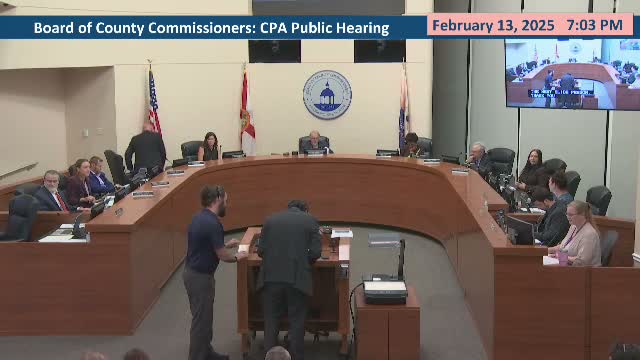
After hours of public comment warning of contamination and traffic, the Board of County Commissioners voted to transmit two Energy Industrial Park plan amendments — one that updates EIP policy and a separate proposal to allow residential uses south of the railroad — after adding conditions requiring expanded testing, no new supply wells/septic, and pre‑construction radiation sampling before any residential occupancy.
The Hillsborough County Board of County Commissioners voted to transmit two privately initiated amendments to the Energy Industrial Park (EIP) plan language on a 6–1 record of votes on motions the board considered the evening. Planning staff said the changes would modernize policy language, allow co‑located renewable energy (for example rooftop solar), and — in one of the petitions — permit residential development at up to three dwelling units per gross acre in a roughly 476‑acre area south of the CSX railroad tracks with a maximum of 1,200 units specified.
Why it matters: Residents and environmental experts said the site is a former phosphate mine that includes a 9.5‑acre Superfund sludge pond and has never been fully sampled across the full 3,000 acres. Opponents warned of radon, a possible 1,4‑dioxane groundwater plume and historic dumping, and pressed the board to pause any plan changes until a comprehensive testing and remedial strategy is complete. Developers said the amendments modernize the rules, strengthen renewable energy commitments and that any residential development would still need subsequent zoning, permitting and environmental approvals.
Planning staff and several county agencies flagged outstanding technical issues. Agency reviewers noted the Sydney Mine Sludge Pond Superfund site is within the EIP area and reiterated that uses or alterations inside or near the sludge ponds must be approved by the Florida Department of Environmental Protection (DEP) and coordinated with the U.S. Environmental Protection Agency. County environmental services asked that applicants submit floodplain and surface‑water maps consistent with FEMA and county surface water maps and flagged restrictive covenants that limit certain uses on parcel(s) inside the institutional control area.
Public comment was strongly opposed. Dozens of residents, neighborhood leaders and technical witnesses urged the board to deny or pause the amendments, saying testing across the 3,000 acres is incomplete, that local wells and private sampling have shown elevated readings and that disturbance of soils could spread contaminants. Resident Penny Martin said, "We must put a pause on these requests…Testing must be required prior to any approval." Doctor James Davidson told the board the county cannot mandate radon mitigation beyond the state law but urged mandatory testing and mitigation at the zoning stage.
Board action and conditions. In response, commissioners added multiple conditions to the transmitted amendments before voting. The measures approved or added to the text that will be transmitted include: a requirement to coordinate any testing and monitoring with federal and state agencies (EPA, DEP), explicit language that "no new supply wells or septic systems shall be allowed" in the area proposed for residential use, a requirement that the developer coordinate with environmental oversight agencies and that preconstruction radiation sampling and any required mitigation or specialized construction be completed prior to issuance of residential certificates of occupancy. Commissioners said the changes are intended to ensure that safety and agency review take place before any residential development could proceed.
What happens next. Transmittal sends the proposed text amendments (and added conditions) to state and regional agencies for review; it is the first of several steps. County staff and applicants repeatedly noted that transmission does not grant permits or rezoning rights — later zoning, PD and development approvals would still be subject to permitting, concurrency tests for central water/sewer, agency environmental approvals and any remediation requirements. Several commissioners emphasized that if required testing or agency permitting cannot demonstrate safe conditions, proposed residential development would not be permitted to proceed.
The board vote to transmit followed extended public testimony and multiple amendments on the record; the motion to transmit passed after the board adopted additional testing and information‑sharing language, with at least one commissioner voting no on portions of the package.