Get Full Government Meeting Transcripts, Videos, & Alerts Forever!
Get email alerts on the Urban Service Area Expansion topic
No spam. Unsubscribe anytime.
Board transmits large urban‑service‑area expansions after hours of public comment and debate on infrastructure
Summary
Hillsborough County commissioners voted 7–0 to transmit four publicly initiated comprehensive plan amendments (HCCPA 2444, 2445, 2446, 2447) proposing large urban service area expansions in the Waimama and Balm/Baum areas, while residents urged infrastructure studies and commissioners proposed using mobility fees locally to pay for needed roads.
The Hillsborough County Board of County Commissioners unanimously voted to transmit for state and agency review four publicly initiated comprehensive plan amendments that would expand the county’s urban service area and increase allowable residential densities across large tracts in southeast unincorporated Hillsborough County.
Melissa Zornita, executive director of the Planning Commission, framed the proposals as a first step in a long planning process. She told commissioners that projections show the county will need space to accommodate hundreds of thousands of new residents and jobs by mid‑century, and that expanding the urban service area is intended to help the county and partner agencies (FDOT, Tampa Bay Water, school district) plan infrastructure and capital investments ahead of demand.
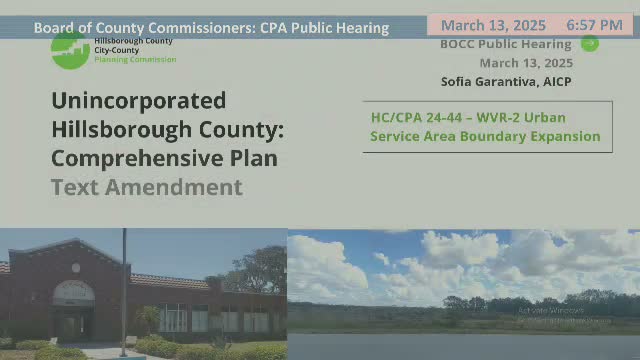
Planning Commission staff (Sophia Guarantiva) presented the Waimama text amendment HCCPA 2444 (proposed expansion of roughly 4,212 acres) and map amendment HCCPA 2445 (about 5,661 acres moving from Waimama Village RP2 to mostly Residential‑4 with some Res‑1 and Natural Preservation). Staff also presented the Balm/Baum package (HCCPA 2446 text ~8,041 acres and HCCPA 2447 map ~10,151 acres). The Planning Commission had voted to find these amendments inconsistent with multiple comprehensive plan policies and recommended further study; staff likewise recorded concerns about infrastructure and natural‑resource protections.
Public comment was extensive and divided. Speakers who urged a pause or an infrastructure study included Ted Canty (Waimama CPAC), who asked the board to commission a comprehensive infrastructure study of flooding, stormwater, roads, schools and emergency services before approving amendments; Mary Meineer and several Berry Bay residents cited traffic congestion, floodplain risk and housing market saturation; Noelle Lacour and others questioned county estimates that the changes would generate a $6 million net revenue figure and said existing roads and public services are already under strain. Pastor Zellvis Aplin and other residents highlighted school capacity numbers and a projection that the combined proposals could add tens of thousands of people and vehicles to local roads.
Supporters included landowners, farmers and representatives who said many of these lands have historically been identified for future urban expansion, that inclusion in the urban service area will allow more efficient capital planning, and that the changes could help agricultural landowners access capital. Several speakers urged the county to preserve conservation corridors and urged targeted protections for specific small outlier parcels that neighbors asked remain rural.
During deliberations Commissioner Whistell proposed, and sought to transmit, a new policy (proposed policy 1.1.8) to require mobility fees generated in an expansion area be spent within that area (or within a quarter mile) to mitigate transportation impacts. Commissioners debated whether to transmit that dedication now so state agencies could comment, or to brief the board and consider adoption at a later public hearing. Staff advised the board a briefing was feasible and that language could be refined before adoption; commissioners asked staff for a briefing and for Planning Commission resources to prepare supplemental materials. The board ultimately voted to transmit the four amendments for state and agency review (each vote recorded 7–0) and directed staff follow‑up for additional engagement and technical detail.
What happens next: The transmittal sends the amendments and proposed plan text changes to state and reviewing agencies for formal comment. Transmittal does not authorize development; any future rezoning, site plan approvals, infrastructure commitments and funding decisions will be required before construction can proceed. Commissioners and staff outlined possible next steps including focused infrastructure studies, mobility fee policy work, and meetings with affected landowners about specific outlier parcels.