Get Full Government Meeting Transcripts, Videos, & Alerts Forever!
Get email alerts on the Urban Service Area Expansion topic
No spam. Unsubscribe anytime.
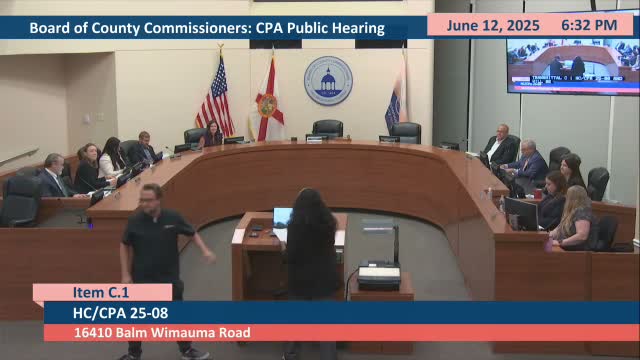
Commission transmits large urban service-area expansion at Bawamama Road after mixed public reaction
Summary
The board voted to find HCCPA 25-08 (470.9-acre urban service area expansion) and associated HCCPA 25-07 (future land use change to Residential 4) consistent and transmitted them for state review; applicants cited conservation easements and transition rationale while neighbors raised flooding, traffic and notification concerns.
Hillsborough County commissioners voted to transmit HCCPA 25-08, a privately initiated request to expand the urban service area by about 470.9 acres at 16410 Bawamama Road, together with HCCPA 25-07, a request to change the site’s future land use from Agriculture Rural 1 to 5 to Residential 4.
Planning staff told commissioners the expansion would bring the acreage into the urban service area and require, at minimum, public water and sewer connections. Staff said the proposal met consistency criteria for urban expansion and recommended transmittal to the state for agency review.
Applicant representatives argued the change was appropriate given surrounding approved densities and the existence of industrial and employment areas nearby. Jake Kramer (Stearns Weaver Miller) described the site as an active borrow-pit that will not remain viable for agriculture long-term and said conservation easements protect parts of the site. “This is for an agricultural landowner that is saying I’ve already done the right thing,” Kramer said. Land planner David Smith described developable area and gave a high-end estimate for potential units, saying, "we're probably looking at, at best, 800 units or, with a more conservative approach, about 630."
Online and in-person public comment was mixed. Thomas Campbell, a nearby resident, voiced support and praised the property owner’s engagement with neighbors. Multiple residents, including Buddy Harwell, Penny Martin and George Nieman, urged denial or deeper review citing flooding, traffic congestion, notification gaps and incompatibility with rural character. Penny Martin told the board, “Please vote no today to convert the small parcel from rural to urban,” and asked for a closer review of alleged inconsistencies in staff analysis.
The applicant offered to work with residents and said detailed engineering (traffic and drainage) will be considered during subsequent zoning reviews. Commissioners moved to find the items consistent and to transmit them for state review; the board recorded votes of 6–0 on the consistency findings and moved the items forward for agency review and later zoning scrutiny.
The transmittal starts state-level review; if returned favorably the applicant will proceed to zoning stages where access, emergency access, buffering and drainage will be reviewed.