Get Full Government Meeting Transcripts, Videos, & Alerts Forever!
Get email alerts on the Transportation Infrastructure topic
No spam. Unsubscribe anytime.
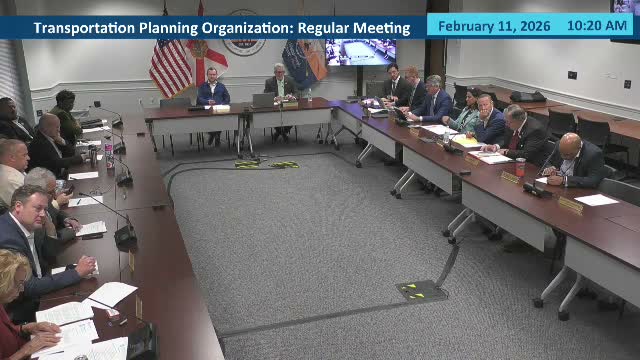
TPO adopts countywide traffic-signal prioritization study after debate over pedestrian access and school buffers
Summary
The Hillsborough TPO adopted a traffic-signal prioritization methodology to rank over 1,200 intersections for upgrades, but board members pressed staff to add a school-buffer list and to field-check pedestrian push-button accessibility before major infrastructure decisions.
Wade Reynolds, TPO staff, introduced a traffic-signal prioritization study developed with Atkins consultants that inventories more than 1,200 signals across Hillsborough County and ranks intersections by resiliency, cabinet condition and proximity to high-injury corridors. Wyatt Bowers of Atkins said the study considered floodplain exposure and structural condition and added points for the Vision Zero high-injury network.
The Citizens Advisory Committee recommended approval but submitted a dissenting letter from Christina Costa and Bridal Inman arguing the methodology omits pedestrian and bicycle push-button accessibility, reach range and audible/tactile features. "The study does not include any assessment or scoring criteria related to pedestrian and bicycle push buttons specifically their presence accessibility operability or physical condition," Rick Fernandez, CAC chair, read from the dissenting document.
Board members pushed for additional work before implementation. Several members asked staff to compile a list of known problematic intersections and for the TPO to present a separate list of signals within a school-zone buffer. Staff and consultants said detailed push-button and ADA accessibility checks require field visits on a case-by-case basis and that adding school proximity as a GIS-derived "fifth bucket" was feasible.
Action and outcome: Commissioner Waspel moved and Commissioner Cohen seconded a motion to approve the study and direct staff to integrate the methodology into the priority-project list. The board voted to adopt the study; staff will return with a school-buffered list (the board discussed a 500-foot buffer) and pursue iterative updates to the methodology and field inventories.
What to watch: The study creates a standardized data template for signal inventories and opens a pathway for agencies to submit SU (surface transportation) funding requests. The CAC dissent and board direction mean the first implementation of the prioritization will be accompanied by a school-buffer list and likely additional ADA-focused field work.