Get Full Government Meeting Transcripts, Videos, & Alerts Forever!
Get email alerts on the Land Use topic
No spam. Unsubscribe anytime.
Planning commission recommends against 40 Ranch Road map change after hours of public comment
Summary
The Hillsborough County Planning Commission voted 8–1 to recommend that HCCPA 25‑37 (40 Ranch Road) be found inconsistent with the county comprehensive plan after a multi‑hour hearing that drew hundreds of residents who raised concerns about water, roads, schools and wildlife. The applicants said the proposed Planned Environmental Community would add protections for wetlands and wildlife corridors but commissioners and staff cited infrastructure and compatibility concerns.
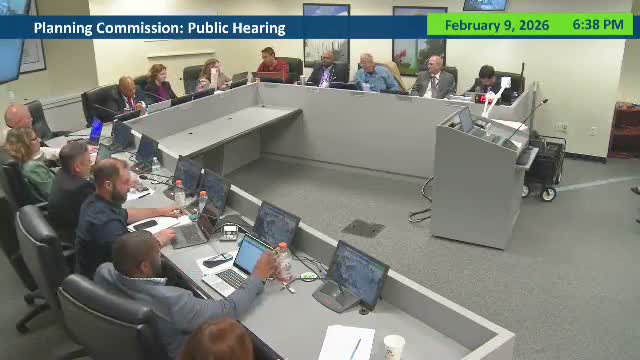
The Hillsborough County Planning Commission voted 8–1 on Feb. 9 to recommend that HCCPA 25‑37 — a privately initiated comprehensive plan map amendment covering the 40 Ranch Road property — be found inconsistent with the unincorporated Hillsborough County comprehensive plan.
Planning commission staff, presented by Jillian Massey, recommended denial, saying the proposed change to a Planned Environmental Community (PEC 1–2) would introduce residential density “significantly out of scale” with surrounding rural land uses, remove long‑designated industrial/mining categories, and put pressure on environmentally sensitive lands, the Hillsborough River watershed and already strained infrastructure.
The applicant, represented by attorney Cammie Corbett of Hill Ward & Henderson, described the property as a long‑held family ranch and argued that converting the site to PEC would impose stronger environmental protections than current designations. “First of all, just to reset this, this is not a rezoning. We’re not asking you to rezone,” Corbett said, emphasizing that any future residential development would require PD rezoning and demonstrated public water and sewer availability.
Environmental consultants for the applicant detailed requirements in the PEC proposal that they said would protect the river corridor and wildlife: larger wetland buffers (the presentation cited a 90‑foot buffer next to the Hillsborough River), mandatory wildlife corridors with minimum upland widths, increased water‑quality and stormwater standards, and conservation obligations enforced by non‑revocable deed restrictions and an environmental management plan prepared with input from the Environmental Protection Commission.
That technical framing did little to blunt public opposition. Dozens of residents — many of whom live within miles of the site — spoke in person and on the phone over more than three hours. Commenters cited repeated concerns about road capacity on two‑lane rural roads, the lack of potable water and wastewater capacity in the area, flooding and stormwater risks (residents repeatedly referenced recent flood events including Hurricane Milton), school capacity, emergency response times and loss of rural character and wildlife habitat.
“This isn’t smart growth. It’s suffocation,” said Jesse Williams, a Plant City resident who told commissioners the plan would add thousands of cars to narrow roads. Eric Sievers, senior ecologist at Wildlands Conservation, told the commission: “This property in question is the most important parcel remaining for preservation in Hillsborough County.”
Commissioners questioned staff and the applicant on how density would be calculated when wetlands are present, the tradeoffs between prohibiting mining/industrial uses and allowing clustered residential units on uplands, and how enforceable the PEC’s environmental protections would be in practice. Staff clarified that the gross‑acreage calculations cited during the hearing produce a theoretical maximum (about 3,900 units on the PEC formula before wetland credits), but that actual buildable units would be reduced by wetlands and by the environmental requirements the PEC would impose.
After deliberation, Commissioner Kona moved to find HCCPA 25‑37 inconsistent with the comprehensive plan; Commissioner Linkus seconded. The motion carried 8–1 on a roll call; Chair Joseph was the lone dissenting vote. The planning commission’s action is a recommendation to the Board of County Commissioners, which will consider the amendment at a later public meeting.
Votes at a glance: The commission also recommended consistency for several other items earlier in the evening, including TACPA 25‑18 (3602 W. Euclid Ave), TACPA 25‑19 (MOSI map amendment), TACPA 25‑20 (11315 N. 46th St. / Mosey area), HCCPA 25‑26 (South Hillsborough County plan text change), and HCCPA 25‑29 (rural light industrial category). Those recommendations will likewise go to the appropriate elected body for final action.
Next steps: The planning commission’s recommendation will be transmitted to the Board of County Commissioners; that board holds the statutory authority to adopt or reject comprehensive plan amendments. The county’s staff and the applicant may provide additional materials and testimony at the BCC hearing.