Get Full Government Meeting Transcripts, Videos, & Alerts Forever!
Get email alerts on the Urban Service Area topic
No spam. Unsubscribe anytime.
Planning commission asks staff for clearer metrics, facilitator options in review of the county's urban service area
Summary
Commissioners debated whether Hillsborough County's 1993 urban service area (USA) remains effective, pressed staff for quantitative metrics (including the origin and value of the plan's 80/20 target), and directed staff to return with educational briefings or a facilitated workshop and consultant options in April—May rather than take immediate action.
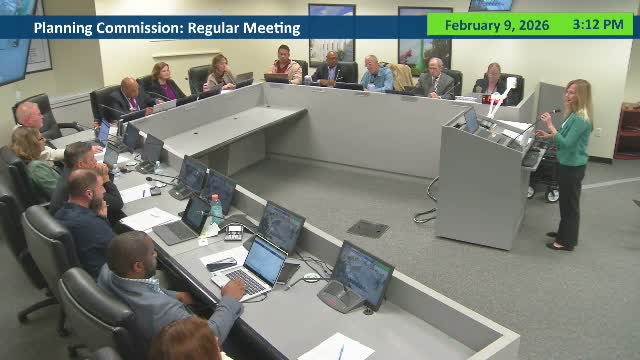
Planning Commission staff on Feb. 9 presented a proposed evaluation of the county's Urban Service Area (USA), a growth-management tool first adopted in 1993 that staff said influences infrastructure investments, fiscal planning and land-use decisions across Hillsborough County.
Melissa Dickens, planning commission staff, described a three-phase approach: (1) analyze current conditions and options; (2) evaluate alternatives in detail (fiscal modeling, transportation, environmental and regulatory implications); and (3) identify implementation steps, including potential land development code changes. Dickens told the commission the study would likely require outside consultant assistance and would draw on ongoing urban expansion-area work for the Little Manatee South and I-4 areas.
Commissioners pressed staff for clarity on purpose and metrics. "What's the problem we are trying to solve with this letter?" asked Commissioner Saint, summarizing the framing question repeated across the dais. Several commissioners asked for the origin and implications of the comprehensive plan's 80/20 metric and whether hitting that target demonstrably produces lower infrastructure costs or better housing outcomes. "We've been hitting that 80 every time. What are we getting from hitting that 80?" one commissioner asked.
Concerns diverged. Some commissioners argued the USA still serves to concentrate growth where infrastructure already exists and to preserve rural and agricultural lands. Others said the tool may be acting as a barrier to redevelopment and housing affordability inside the urban core, noting that regulations inside the USA can make infill development more expensive and push growth toward expansion areas.
Several commissioners and staff supported using outside expertise. The commission discussed a two-step path: first, an educational or facilitator-led workshop to establish clear objectives and metrics; second, a consultant-led evaluation if warranted. Staff suggested county departments (capital facilities, development services, schools) should also brief the commission to clarify how the USA is used in practice.
No formal motion or policy change was adopted. The commission requested staff return with options for a workshop or initial scoping for consultant work and additional education from county departments, with a goal of returning to the commission in the April—May timeframe. Planning staff said ongoing UEA outreach will produce draft scenarios mid- to late summer and that the full UEA studies are expected to conclude by year-end.
Commissioners asked that any consultant or facilitator provide independent, comparative perspectives and possible performance metrics (gap analyses, fiscal impacts, and measurable indicators of whether the USA is achieving its stated goals).