Gettysburg Area SD previews 2026–27 budget with multimillion‑dollar shortfall driven by special‑education costs
Loading...
Summary
District finance staff presented a preliminary $85.9M spending plan and $79.7M in operating revenues for 2026–27, outlining a structural gap (several million dollars) largely tied to rising special‑education needs after Intermediate Unit service changes.
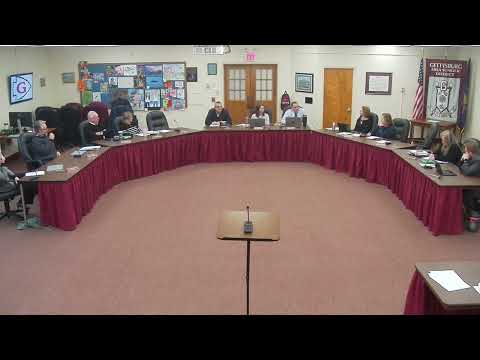
The Gettysburg Area School District on Monday reviewed a preliminary 2026–27 operating budget that projects $79.7 million in revenue against $85.9 million in proposed expenditures, producing a multimillion‑dollar shortfall driven principally by rising special‑education costs and higher salary and benefit expenses.
Belinda, the district presenter, told the board the operating‑revenue estimate includes about $54.0 million in local funds, $24.4 million in state funds and roughly $1.13 million in federal program funding. "The majority of our budget, of course, is local funds," she said, noting that the governor's proposal is unlikely to materially change the state's share.
The presentation framed a timeline required by state law: advertise the proposed budget by April 20, hold a public hearing May 4 and adopt a final budget by June 1. Staff described the district's unassigned fund balance as declining in recent years (24 days of operating cash in 2021 to about 13–15 days projected under the proposal). "This is not a good budget situation to be in," Belinda said.
Board discussion focused on the principal driver of the gap: changes to Intermediate Unit (IU/LIU) services that have led the district to bring additional special‑education responsibilities in‑house. Belinda said GASD is committing to seven special‑education positions as part of a comprehensive plan (four added in 2025–26 and three more anticipated in 2026–27), and estimated the approximate out‑of‑district cost for an autistic‑support student at about $70,000. "We are anticipating a service of 58 autistic support students over a four‑year window," she said, and noted in‑district placement costs currently cited at roughly $60,400 per student in existing conditions.
Board members and staff discussed options to close the shortfall. Belinda outlined the arithmetic under different local tax scenarios: with a 0% tax increase the district would still face more than a $6 million gap; a 1% increase reduces the gap but does not eliminate it; even the full Act 1 index (4.2%) would leave a multi‑million‑dollar shortfall. She said the administration is reviewing positions, contracts and capital‑reserve decisions, and will continue to present updates to the board.
The board asked for follow‑up information on assumptions (including residency verification work that could recover revenue), the composition of the unassigned fund balance, and more detailed cost comparisons between in‑district and out‑of‑district special‑education placements. Belinda invited board members to submit additional questions by email.
The board will receive further budget updates this spring, with formal adoption scheduled for the June meeting cycle.