
Senate debates Capitol security bill that would bar weapons but carve out concealed-carry exception
Get AI-powered insights, summaries, and transcripts
Subscribe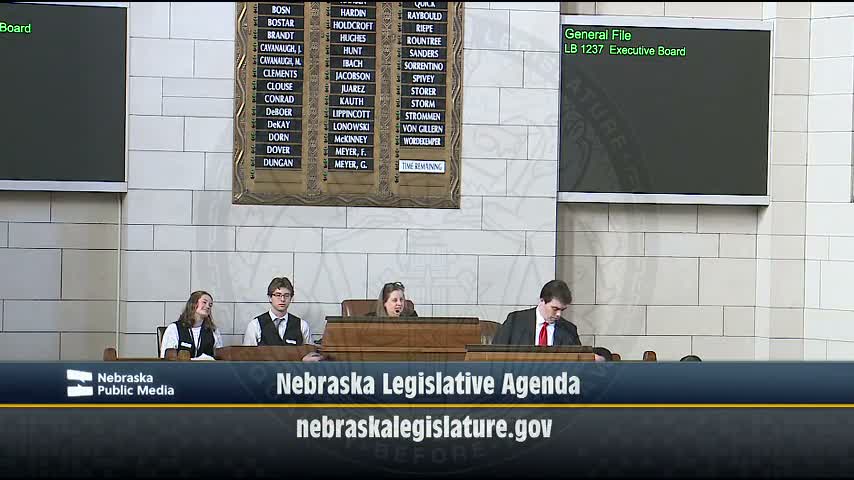
Summary
LB12 37 would prohibit knowingly bringing weapons or prohibited substances into the Nebraska State Capitol and give the State Patrol responsibility for screening; the committee amendment permits concealed-carry permit holders to carry concealed handguns. Senators traded sharply over implementation costs, ADA access, enforcement details and concerns about political weaponization of security.
The Executive Board’s LB12 37, taken up on general file, would prohibit knowingly entering the Nebraska State Capitol with weapons or specified prohibited items, classify violations as a class 3 misdemeanor, and assign primary responsibility for capitol security to the Nebraska State Patrol. An adopted committee amendment (AM2028) adds an exception allowing individuals holding current concealed-carry permits issued under the state’s law to carry a concealed handgun in the capitol.
Sponsor Sen. Hansen described two implementation options in the fiscal note: a two–public-entry-point approach estimated at about $1.4 million in the first fiscal year and $1.5 million annually thereafter, and a single-entry option (likely the West entrance) estimated at roughly $870,000 in the first fiscal year and lower ongoing costs. The Department of Administrative Services also estimated a small initial cost for electrical conduit for metal-detector installations and noted potential ADA upgrades for some entrances.
Floor debate was extensive and often pointed. Sen. Conrad, among others, raised concerns about vague statutory definitions (for example, what counts as an "incendiary device"), delegation of broad operational authority to the State Patrol or executive board, and the potential for a two-tiered entry system that could give expedited access to some groups. Conrad also warned about "political weaponization" of security and cited incidents where footage had been posted to political accounts. Sen. Hunt said she opposed the bill's approach to metal detectors and emphasized trust in the State Patrol; Sen. Anderson and others supported the bill as a balanced way to improve safety while preserving certain rights for permit holders.
Why it matters: The bill would alter public access to the Capitol, change how security is implemented and funded, and create a criminal prohibition and exemption framework affecting citizens, visitors and officeholders. The exception for concealed-carry permit holders and questions about which entrances are used, ADA access and procedures for verification were focal points of the debate.
What’s next: Senators discussed select-file amendments and further work on definitions and operational protocols. The body did not finalize all implementation details on the floor; sponsors said they would return with adjustments and coordinate with the State Patrol.