
Committee hears plan to raise State Patrol retirement age to 65 and restore DROP eligibility
Get AI-powered insights, summaries, and transcripts
Subscribe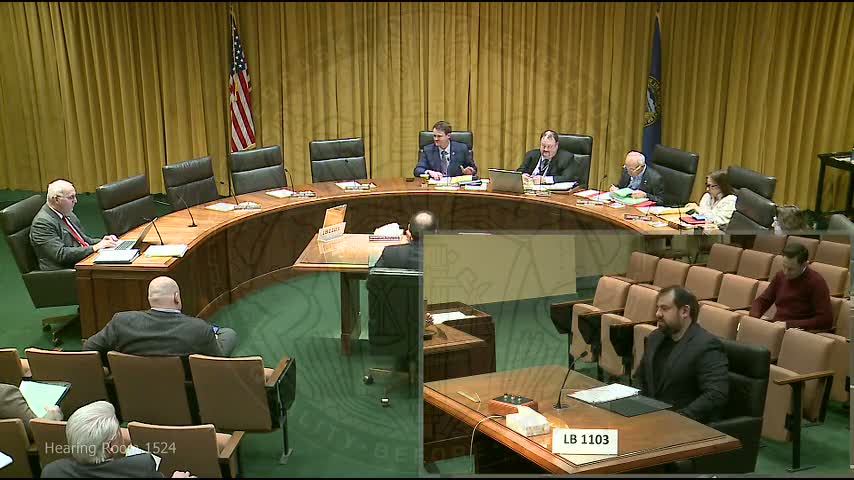
Summary
The Nebraska Retirement Systems Committee heard testimony on LB1103, which would raise the mandatory retirement age for Nebraska State Patrol members from 60 to 65 and allow members hired on or after July 1, 2016, to enter the deferred retirement option plan (DROP). Supporters said the measures would improve retention with little expected actuarial cost.
LINCOLN — The Nebraska Legislature’s Retirement Systems Committee heard LB1103 on behalf of Senator Eli Bostar, a bill that would let some Nebraska State Patrol members work past age 60 and restore access to the deferred retirement option plan for certain newer hires.
Senator Eli Bostar, who introduced the bill, said the two changes are straightforward and aimed at retaining experienced troopers. "These changes are simple adjustments that will increase retention of Nebraska State Patrol members and make certain that they are fairly compensated for a career keeping us all safe," he said. Bostar told the committee an actuarial study in the record (transcribed as conducted by "CABMAC actuarial consulting services" for the Nebraska Public Employees Retirement Systems) concluded the changes are not expected to have a material effect on the retirement system’s funding status.
Supporters emphasized recruitment and retention. Lucas Bolton, a criminal investigator who testified for the State Troopers Association of Nebraska, said restoring DROP is a proven retention tool because it allows experienced troopers to remain on the job beyond initial retirement eligibility. He testified that "roughly 210 troopers" who graduated since 2016 are currently ineligible for DROP and said staffing estimates show the patrol’s workforce figures that make access to DROP important for continuity. Bolton also framed the retirement-age change as a way to close the coverage gap between forced retirement at 60 and Medicare eligibility.
Retired trooper Frederick Storm described how DROP affected his retirement and offered an on-the-record comparison of health-care costs: "As I looked at the paperwork, it's going to cost $2,000 a month for health care coverage for me and my wife if I went through the state program... Because I am able to go through my wife being in Medicare... our cost is about $250," he said, arguing that the ability to work longer and access DROP can ease that transition for troopers.
Senator Bostar and witnesses also cited staffing pressures. Bostar answered a committee question that the patrol currently has about 54 vacancies; earlier witnesses estimated shortages "around 50 or 60." Testimony explained that allowing some troopers to work until 65 does not change the 25-year maximum benefit service cap but helps those who start later in life reach full service and remain available to mentor newer officers.
There were four proponent witnesses, no opponents and no neutral witnesses listed for LB1103 in the committee record. No committee action or vote was taken at the hearing; the committee will decide next steps in future proceedings.
Why it matters: Committee members heard consistent testimony that the measures aim to keep experienced, trained troopers on duty longer to stabilize staffing and preserve institutional knowledge while actuarial analysis in the record projects minimal funding impact.
What’s next: The bill was left before the committee for further consideration; proponents urged the committee to advance LB1103.