Conrad revives 'attorney retention sunshine' bill; AG's office warns disclosure could hamper litigation
Loading...
Summary
Sen. Danielle Conrad said LB975 would increase transparency by requiring the attorney general to disclose outside counsel contracts; Jennifer Huxell, civil litigation bureau chief for the attorney general, testified the bill could slow hiring and hamper litigation strategy given short court-response deadlines.
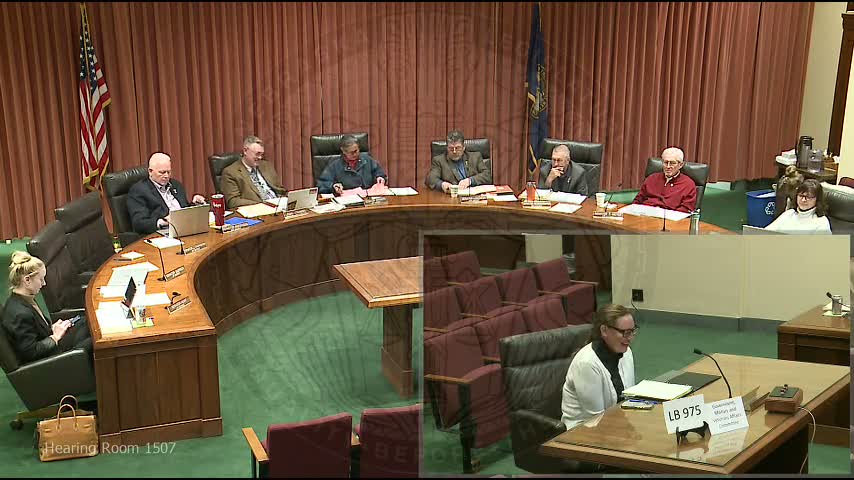
Sen. Danielle Conrad introduced LB975, the "Attorney Retention Sunshine Act" model measure, telling the Government, Military and Veterans Affairs Committee the bill would set clearer requirements for the attorney general when contracting for outside legal services and increase public oversight of taxpayer-funded outside counsel.
"This measure has been adopted in many of our sister states," Conrad said, asking the committee to consider transparency in how the attorney general retains outside lawyers. She highlighted what she described as a large increase in the attorney general's general-fund budget in recent years and disputed an attorney general fiscal note that estimated significant administrative cost to implement the measure.
Jennifer Huxell, civil litigation bureau chief for the attorney general's office, opposed the bill. She said many civil defense matters require a prompt retention decision — the office typically has 21 days in federal court and 30 days in state court to respond — and that LB975's contract-filing triggers (contracts reasonably expected to exceed $10,000 must be filed with the Appropriations Committee) would effectively require review of nearly every civil case. Huxell said that process would make timely hiring of specialized counsel harder and could compromise litigation strategy and confidentiality.
Committee members asked whether the bill's $1,000-per-hour cap was per attorney or per team, whether there is evidence of systemic excessive fees, and how procurement-like review could be reconciled with rapid litigation needs. Conrad said the $1,000 figure functions as an individual ceiling in the model and offered to work with the attorney general's office to refine the measure. Huxell said she has not identified systemic overbilling or auditor referrals but emphasized that many cases require retaining out-of-state boutique firms to match national defendants.
Conrad closed by noting 15–20 states have adopted similar model provisions and by offering to collaborate on technical fixes. The committee closed the hearing; no committee action was taken.