Get Full Government Meeting Transcripts, Videos, & Alerts Forever!
Get email alerts on the Impact Fees topic
No spam. Unsubscribe anytime.
Hillsborough commissioners approve steep water and wastewater impact fee increases for South Central service area with phased options
Summary
After hearings and public comments urging a phased approach, the Hillsborough County commission approved a demonstrated-needs finding and a two-thirds vote to raise impact fees—proposing a jump from about $5,865 to $13,270 per ERU in South Central—while offering phase-in options to soften near-term effects.
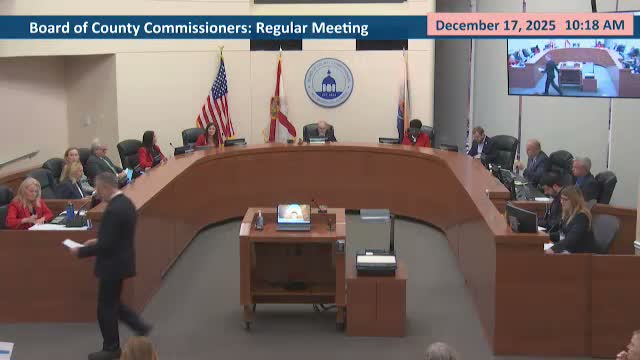
Hillsborough County commissioners on Dec. 17 approved a demonstrated-needs finding and accompanying ordinance that will sharply raise water and wastewater impact fees in the county's South Central service area.
County staff and consultant Stantec told the board that extraordinary growth and rapid cost escalation in recent years drove the recommendation: planners cited about a 22% recent increase in demand in the South Central area and benchmarked construction-cost spikes—pipelines up over 200% and wastewater treatment facilities up more than 300% in roughly five years. Based on those figures, staff presented a fee that would increase combined water and wastewater impact fees from $5,865 per equivalent residential connection (ERC/ERU) to $13,270 in South Central.
The proposal included multiple implementation schedules: immediate full implementation, two-, three- and four-year phase-ins, and a countywide mirror of the Northwest phased approach. Speakers at the public hearing urged a phased implementation and more public engagement. Todd Josko of NAIOP Tampa Bay and attorney Kamie Corbett representing development interests said the materials were released to the public late in the process and asked the board to adopt longer phase-ins to avoid abrupt cost shocks for builders and buyers.
Commissioners debated competing goals: covering the full cost of new system capacity, honoring board policies on fee recovery, protecting ratepayers from subsidizing growth in other service areas, and avoiding sudden added costs to homes already in the permitting pipeline. Several commissioners said their preference was for a phased approach to minimize immediate consumer impacts but emphasized that legislative timing limited delay options; staff said state timing could make future increases harder to achieve. The board agreed to implement the fees under a phased option after discussion and recorded the requisite two-thirds approval.
Board members also asked staff to codify and protect applicants already in the permitting queue so projects submitted before the effective date would not be penalized by the higher fee. Staff said the county historically honored rates for applications already in the queue and would return with formal process language.
The ordinance takes effect 90 days after formal adoption unless the board specifies otherwise; staff said implementation details and final phase-in schedules will be published with the adopted ordinance.
What happens next: staff will finalize the implementation schedule, publish the final ordinance and fee schedule, and return with administrative language to protect applicants already in the pipeline. The board also directed follow-up work on fee-review cadence and the relationship between impact fees and user-rate policy.