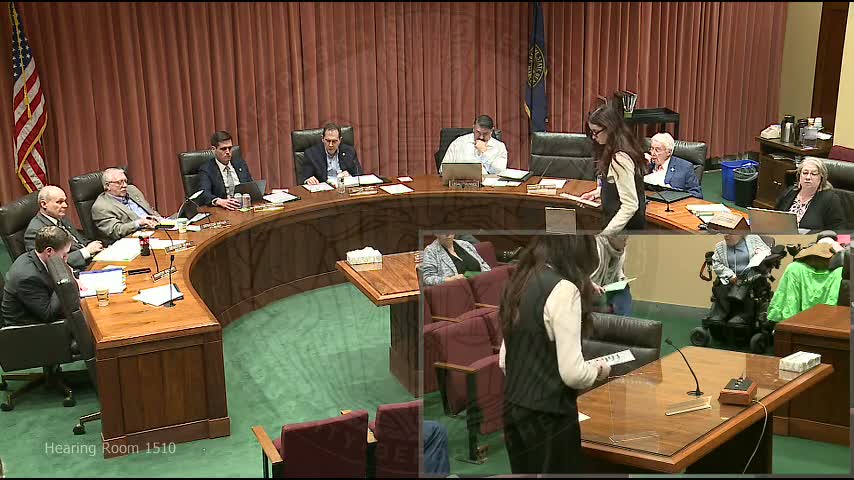
Committee hears bill to return small group of special‑needs long‑term care clients to fee‑for‑service
Loading...
Summary
Sen. Elliot Bostar and providers urged the Health and Human Services Committee to advance LB1091, which would remove skilled nursing and special‑needs long‑term care services for a narrow group of medically complex Medicaid beneficiaries from Heritage Health managed care and return those services to fee‑for‑service to preserve continuity of care.
Senator Elliot Bostar, the bill’s introducer, told the Health and Human Services Committee that LB1091 would exclude skilled nursing and other long‑term care services for a narrowly defined group of medically complex Medicaid beneficiaries from the state’s managed‑care program (Heritage Health) and shift those services to fee‑for‑service Medicaid. He said the change would affect “fewer than 150 Medicaid beneficiaries” of nearly 300,000 enrolled in Heritage Health and is intended to protect continuity and specialized care.
Providers and family members who testified supported the proposal. Nashma Huppete, president and CEO of QLI, said managed care organizations (MCOs) have denied admissions and continued care for the program’s population since Heritage Health’s 2017 implementation and described clinical outcomes QLI tracks. “When the most appropriate level of care is provided, long‑term outcomes improve, and we know long‑term costs decrease,” Huppete said, adding that “90 percent of the people that we serve at QLI go home.” Other special‑needs providers (Madonna Rehabilitation, Ambassador Health) described declines in Medicaid‑covered admissions and presented data they said show displaced patient days shifted to higher‑cost acute care.
Robert M. Bell, executive director of the Nebraska Association of Medicaid Health Plans, spoke in respectful opposition on behalf of the state’s three MCOs. Bell warned that carving core specialty services out of managed care could fragment care coordination because managed care coordinates physical health, behavioral health, pharmacy and specialty services under a single accountable structure. He said carve‑outs create parallel administrative infrastructure and risk gaps in transitions between care settings.
Senators asked about scale and fiscal impact; Bostar said AM2194, a clarifying amendment worked on with DHHS and the governor’s office, removes the fiscal note and preserves budget neutrality. Committee members discussed tradeoffs between integrated care coordination and the bills’ targeted goal to stabilize services for a small, high‑needs cohort.
The hearing record showed broad provider and family support and organized opposition from Medicaid health plans. The committee concluded the LB1091 hearing with the sponsor’s closing and the official record noting proponents and testimony; no vote was recorded at the hearing stage.