
Appropriations panel hears bill to match EPA grant for Norfolk wastewater upgrades tied to dairy expansion
Get AI-powered insights, summaries, and transcripts
Subscribe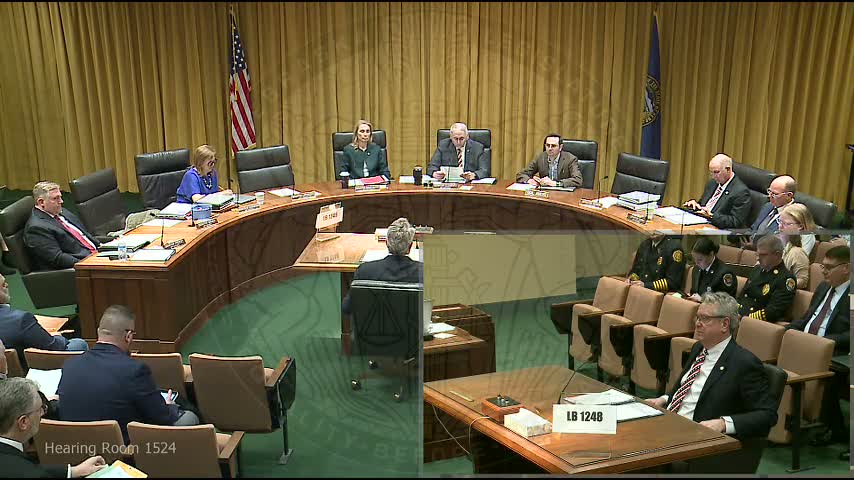
Summary
The Appropriations Committee heard testimony on LB1248, a contingent state appropriation that would allow Nebraska to match EPA Climate Pollution Reduction Grant funds to build an industrial pretreatment system for Norfolk’s wastewater plant; the bill requires a 50% local match and takes effect only if federal funding is awarded.
The Appropriations Committee heard from state and local leaders on LB1248, a contingent appropriation that would let Nebraska provide matching funds if the U.S. EPA’s Climate Pollution Reduction Grant is available and approved for wastewater pretreatment projects. Sen. Robert Dover, the bill’s sponsor, told the committee the appropriation is “sought if and only if federal funds awarded through the United States Environmental Protection Agency's Climate Pollution Reduction Grant may be used for the purposes outlined in this bill.”
Norfolk Mayor Shane Clausen and city engineers argued the project addresses a capacity ceiling that is limiting regional dairy processing and associated employment. Steven Ramess, Norfolk’s public works director, provided technical detail: Norfolk’s organic treatment capacity is currently about 30,000–35,000 pounds of biological oxygen demand (BOD) per day; the two dairy processors now consume ~16,000 pounds and seek an allocation of ~32,000 pounds per day to operate at scale. Ramess described a proposed industrial pretreatment site, two lagoons and a four‑cell sequencing batch reactor, and said the city would phase the project with phase‑one operations targeted in the third quarter of 2028 and phase two in the fourth quarter of 2029.
Representatives of local dairy processors, including an Active Nutrition official, said companies are prepared to contribute toward their share of costs but have not finalized exact match calculations. Farmer witnesses said access to nearby processing capacity preserved farms and brought young people back to rural communities. Testimony emphasized that LB1248 is narrowly tailored as a match only if the EPA grant is awarded; Dover repeated that ‘‘if those federal funds do come through, this legislation allows Nebraska to match them in a responsible partnership.” The committee took testimony and closed the hearing; no committee vote was recorded on LB1248 during the session.
Next steps: The bill is contingent on a decision by EPA; if the federal award is not made or permitted uses are disallowed, LB1248 would have no fiscal effect.