
Glendale Elementary approves FY2026 budget revision as officials warn of steep enrollment decline
Get AI-powered insights, summaries, and transcripts
Subscribe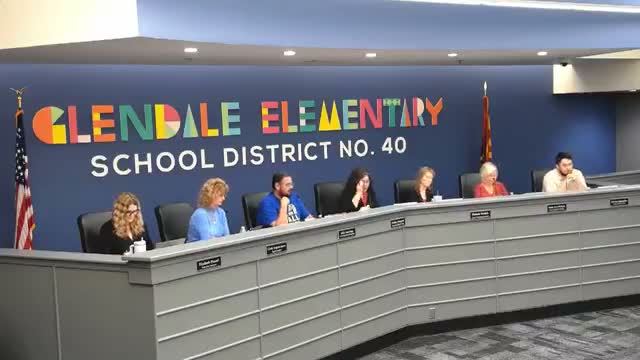
Summary
The Glendale Elementary School District governing board on Feb. 12 approved a FY2026 expenditure budget revision after administrators warned of a projected 22.1% enrollment decline over nine years and shrinking reserves; the superintendent also announced a one‑year retention stipend and a $500 one‑time grant for recent hires.
The Glendale Elementary School District Governing Board on Feb. 12 voted to approve an FY2026 expenditure budget revision after administrators warned the district faces a long-term drop in average daily membership and reduced reserves.
District finance lead Michael Berrigan told the board the district’s current ADM is 7,765 — slightly higher than projected — but cited an Applied Economics projection that ADM could decline roughly 22.1% over the next nine years. "That’s a decrease of about 558 students or ADM," Berrigan said, adding that the change equates to an average loss of about $1.3 million in revenue per year and could reduce carryforward reserves significantly. He told the board the administration would not recommend adding ongoing fixed costs while projections remain uncertain.
The board discussed where pressures are concentrated, including special education and transportation contracts. Superintendent Cindy Sagata Jones highlighted that some students require outside placements and contracted services that raise costs: "It takes a lot to educate children with special needs...and we have to contract out those services," she said, describing how those expenses have increased without a corresponding rise in state funding.
Despite the warning about long-term fiscal risk, the board approved the revision after a motion and roll-call vote; each member present voted in favor. The motion as presented by the board passed by unanimous vote.
In the district update that followed the budget discussion, Superintendent Sagata Jones announced a personnel decision tied to retention and recruitment pressures. The administration will fund a one‑year retention stipend for school year 2025–26 under existing tiered categories and provide a one-time $500 stipend to employees who began work on or after July 1, 2025 and remain employed. Sagata Jones cautioned the board that the one-time payments will narrow resources in future years and said Phase 2 of budget planning — scheduled for presentation in June — will look at longer-term adjustments.
Public comment earlier in the meeting had pressed the board on staff pay. Robert Gale, a teacher and local union secretary, told the board hundreds of staff members are worried about stagnant base pay and said nearly half of surveyed employees wanted financial clarity before signing contracts; about 25% favored a 5% or greater raise. The superintendent’s one‑year stipend and the $500 retention payment address immediate retention concerns but, as administrators and board members noted, leave longer‑term funding questions to future budget phases.
Next steps: administration will present Phase 2 of budget options in June and report back on how the one‑time stipend affects reserves and program planning. The board also asked for comparisons of the district’s salary schedule with neighboring districts as part of future reports.
Vote at a glance: FY2026 expenditure budget revision — approved, unanimous.