Get Full Government Meeting Transcripts, Videos, & Alerts Forever!
Get email alerts on the Traffic Calming topic
No spam. Unsubscribe anytime.
Traffic study: stop‑sign runs common and Wildwood carries heavy cut‑through volumes in New Hampshire Gardens
Summary
Consultants reviewed traffic counts, stop‑sign camera pilot data and resident input in the New Hampshire Gardens traffic study, saying stop‑sign violations exceed 80% at some intersections and weekday volumes on Wildwood reached roughly 2,600 vehicles per day; residents were asked to complete a survey open through Dec. 8.
Consultants presenting a traffic study for the New Hampshire Gardens neighborhood told residents on a cold, well‑attended night that stop‑sign violations and cut‑through commuter volumes are larger than expected and that the team will recommend targeted traffic‑calming measures to the city council in January.
The study team, led by Hector Chang of "tool design," said recent pilot camera counts at three intersections showed "violation rates of 80% and above," and portable counters on five local streets recorded weekday daily volumes of about 2,600 vehicles on Wildwood, 1,600 on Glenside and 1,100 on Kennewick — high figures for a neighborhood the team estimated has roughly 1,600 residents. "There are definitely egregious behaviour[s] happening in the neighbourhood," the consultant said during the presentation.
Why it matters: the combination of high vehicle volumes and short time savings on the main road means navigation algorithms and commuter drivers are using neighborhood streets to save a few minutes. The team’s automated routing tests — run every 15 minutes for a week — showed trips through Wildwood and Glenside often take about five minutes while the same movement on main roads can take six to 10 minutes during PM peak traffic, a difference that encourages cut‑through routing.
Key findings and data
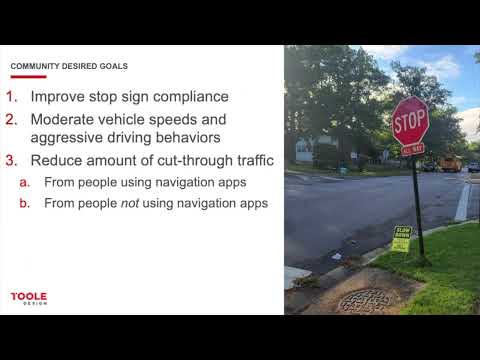
• Stop‑sign compliance: A recent stop‑sign camera pilot recorded very high noncompliance at three intersections; the team said the cameras will be redeployed and that ticketing is expected to begin in early January. "You can see violation rates of 80% and above," the presenter said.
• Vehicle volumes and speeds: Portable counters show substantial volumes relative to neighborhood size. Average speeds on some corridors were well below posted limits during peaks (around 12–14 mph on the most congested blocks), but certain straight segments saw higher average speeds.
• Travel times and routing: Automated routing queries indicate that, during peak periods, the main roads’ travel times increase enough that routing algorithms favor shorter neighborhood paths, helping explain persistent cut‑through traffic.
Options presented to residents
The team outlined a menu of interventions and explained expected tradeoffs and implementation timeframes: low‑cost, quick improvements (wider stop bars, double‑posted stop signs, painted high‑visibility crosswalks and LED stop signs); mid‑block and intersection measures (speed humps, chicanes, curb extensions, raised crossings); and measures that reduce or eliminate cut‑through routing (one‑way conversions, traffic diverters, time‑limited do‑not‑enter signs and permanent street closures).
Hammond Avenue case: as an add‑on to the study, consultants examined a potential one‑way conversion on Hammond Avenue (Lockney/Lochney to Ann Street). They reported PM peak counts of roughly 25 northbound vehicles and 2 southbound vehicles on that segment and cautioned a one‑way conversion could shift roughly 25 cars onto adjacent Kennewick rather than remove them.
Residents’ concerns and feedback
Residents raised enforcement, driveway access at peak times, driver behavior at small traffic circles, and whether interventions would simply divert traffic. One resident described never being able to get in or out of a driveway during rush hour; another recommended placing time‑limited do‑not‑enter signs at New Hampshire Avenue entry points to prevent drivers from entering the neighborhood in the first place. The consultant said a combination of diverters and closures — tested as pilots before permanent construction — can be used to make neighborhood trips longer than main‑road alternatives and reduce algorithmic routing through the area.
Quotes
• "We can see violation rates of 80% and above," the team reported about stop‑sign cameras. • "We're seeing volumes of 2,600 vehicles per day on Wildwood," the consultant said. • On enforcement: a city staff member confirmed, "They're supposed to be ticketing come January," referring to stop‑sign camera citations.
Next steps and what residents can do
The online feedback survey remains open through Monday, Dec. 8 at 8 p.m.; the consultants said they will incorporate resident preferences into a final recommendations report for council in early January. The team emphasized pilots (paint, flex posts, temporary diverters) as lower‑cost, faster tests before any permanent curb or pavement work.
The meeting closed with organizers thanking residents for detailed questions and urging broad survey participation so recommendations reflect neighborhood priorities and tradeoffs.