Brentwood outlines SB 1383 organics rollout, keeps biweekly collection for now
Loading...
Summary
Brentwood Public Works said it will begin implementing California's SB 1383 organics requirements in February 2026 with green-cart collection, new lids and labels, education-focused enforcement and quarterly audits; staff said the initial plan keeps biweekly pickup to avoid rate increases and will be monitored for one summer before any change.
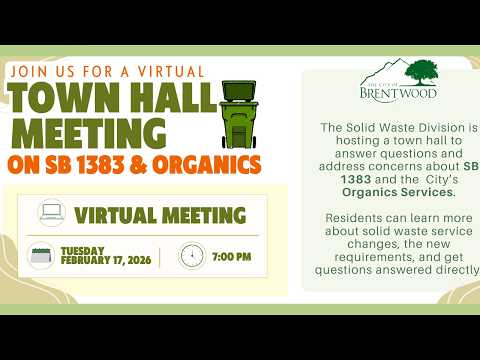
Brentwood public works officials told residents on a city-hosted Zoom meeting that the city will begin implementing California's SB 1383 organics-diversion requirements in February 2026 and will rely on curbside green-cart collection, education and audits rather than immediate fines.
"SB 1383 requires every community in the state to divert organic waste out of landfills," said John Carlson, the city's solid waste manager, during a presentation that outlined what counts as organics and how the city will comply. Carlson said the city abandoned an earlier plan to install on-site mechanical extraction systems after projected capital costs rose from about $50 million to about $160 million.
The program will require residents to place food scraps and food-soiled paper in a green organics cart instead of the brown garbage cart. Staff said new lids and molded labels (green for organics, blue for recycling, gray or black for garbage) will meet state requirements; the city will change lids rather than replace full carts to limit costs and expects the lid replacement effort to take several years, with the state allowing jurisdictions to comply through 2035.
"This program, as presented, will meet the state's unfunded mandate with no rate increases," Carlson said, adding the city's first emphasis will be education. Casey Wickerd, public works director, said the city aims to avoid becoming "garbage police," relying instead on drivers' camera footage and quarterly transfer-station audits to measure contamination.
Wickerd described the audit process: staff will sample truckloads and examine roughly 200 pounds of material to calculate the percentage of organic contamination, a metric used to gauge compliance over time. Carlson said drivers will tag carts with contamination notes for residents and that enforcement beyond education is a last resort.
Residents asked about collection frequency, odors, pests and compostable bags. Several residents urged weekly organics pickup; staff said most agencies report only a 1'2% reduction in brown-cart volume after organics programs, so switching pickup schedules immediately would likely require more trucks, extra routes and a rate increase. "If biweekly collection is truly ineffective for the majority of residents, the city is prepared to consider transitioning organics to weekly collection," Wickerd said, noting that change would require City Council review and public input.
On compostable bags, Carlson said many BPI-certified bags are not accepted by commercial composters because most plants operate on roughly six-week cycles while many BPI standards assume longer decomposition times. He said the city will investigate newer products that residents and attendees mentioned, such as CMA-certified bags, and update guidance if processors accept them.
Staff also described resident supports and logistics: accounts may request a second green cart at no charge; the city is procuring kitchen pails to distribute to residents within about a month; used cooking oil should be taken to the Delta Diablo hazardous-waste facility; and cart exchanges (for cleaning or replacement) carry a $50 fee. Carlson said compost produced at the processing facility in Stockton takes about six weeks and that some finished compost will be returned to Brentwood for parks and giveaways.
Several residents raised concerns about rodents and hot summer conditions increasing odors. Carlson said the lid design will remain the same except for color and labeling and that the city will closely monitor the first summer of rollout and adjust as needed.
The meeting closed with contact information for follow-up: Public Works Director Casey Wickerd provided the main office number, (925) 516-6000, and said staff will post additional materials and updates on the city's website and social media.
What happens next: Brentwood will begin swapping lids as new stock arrives in the coming month, start educational outreach and perform ongoing audits and camera monitoring; any decision to move to weekly organics collection would be considered later by the City Council and would depend on monitoring results and resident input.