Get Full Government Meeting Transcripts, Videos, & Alerts Forever!
Get email alerts on the Waste Management topic
No spam. Unsubscribe anytime.
City to pilot curbside food‑waste collection in Hawaii Kai beginning April 1, 2026
Summary
The city’s Department of Environmental Services will add food scraps to green‑waste carts in a pilot starting April 1, 2026, with Hawaiian Earth Recycling as contractor; the program will accept a wide range of food items but will exclude liquids, fats/oils/grease and compostable containers for now because of PFAS concerns.
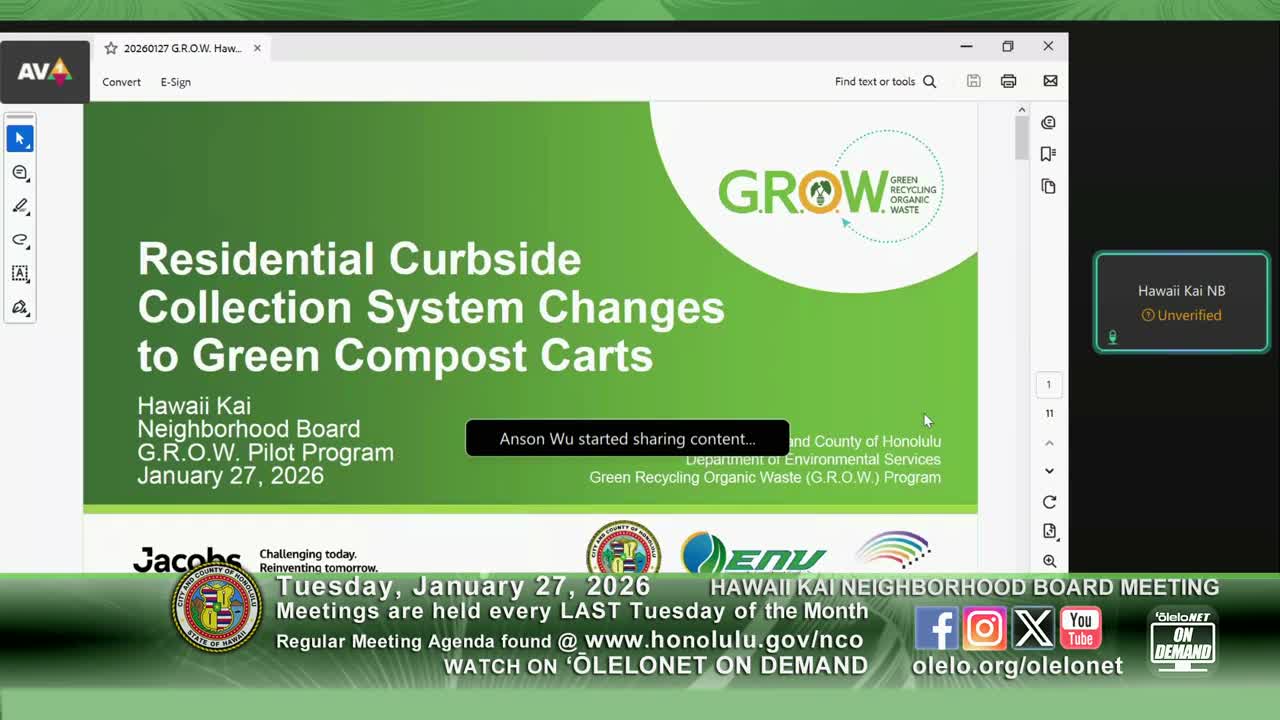
The City and County of Honolulu plans to start a pilot curbside food‑waste program in parts of the island, including Hawaii Kai, on April 1, 2026, the Department of Environmental Services told the neighborhood board.
"We want your your food waste," Henry Gabriel, recycling‑program branch chief, said in his presentation introducing the GROW (Green Recycling Organic Waste) pilot. Under the plan, residents in pilot neighborhoods will continue to use their existing green composting cart on the same pickup schedule; the city will mail notices and hold community workshops before launch.
The contractor, Hawaiian Earth Recycling, will accept food scraps and green waste in curbside loads for in‑vessel composting. Gabriel listed accepted items that will go into the green cart: fruits, vegetables, dairy, bread and other baked goods, pasta and rice, meats and poultry, and typical yard trimmings. He emphasized items the pilot will not accept initially: liquids, fat/oil/grease, paper products, plastic, metal, glass and currently marketed "compostable" serviceware because of concerns about PFAS contamination in finished compost.
Gabriel said residents who live in townhouses or condo complexes that are privately serviced may use commercial drop‑off at Hawaiian Earth Recycling (two loads per day) while the city evaluates options such as smaller trucks or drop‑off sites for multiunit buildings. The department will conduct contamination monitoring—inspecting carts and truckloads during the pilot—and focus on education rather than enforcement; there will be no fines during the pilot.
Board members raised practical questions about rodent control, freezer storage suggestions, and access for residents who cannot freezer‑store scraps or who live down alleys. Gabriel said the department will provide kitchen pails and reusable bags at workshops and will consider drop‑off points as a next phase if the curbside pilot matures.
The pilot’s goals are to divert residential food and green waste from incineration and landfills, speed compost production compared with existing windrow methods, and reduce pressure on H‑POWER and landfill capacity. The department said its web page—envhonolulu.gov/opala—has project materials and that neighborhood workshops will be scheduled.