Get Full Government Meeting Transcripts, Videos, & Alerts Forever!
Get email alerts on the Transportation topic
No spam. Unsubscribe anytime.
Manoa board asks study of 5‑Corners roundabout, but proposal fails after public and member opposition
Summary
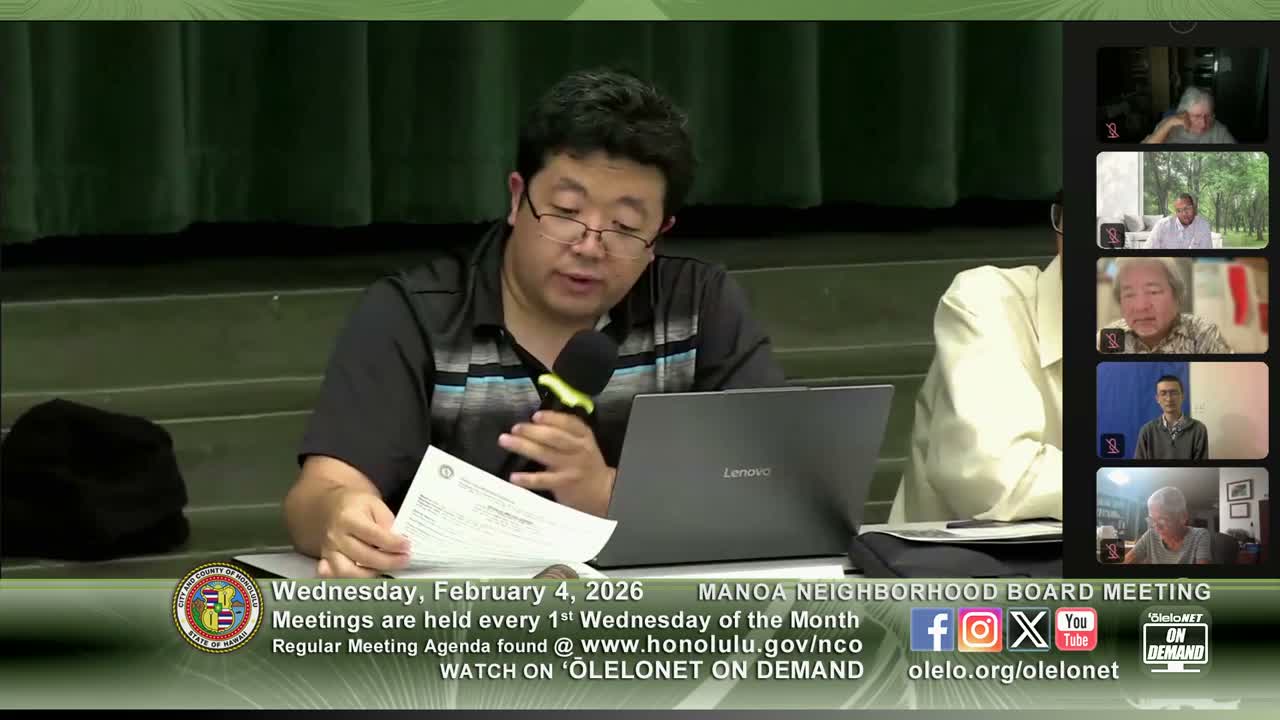
After an hours‑long discussion and extensive public comment, the Manoa Neighborhood Board voted 2–8 with two abstentions against asking the City Council to consider installing a raised roundabout at the '5‑Corners' intersection; concerns centered on buses, property impacts, trees and EMS response times.
The Manoa Neighborhood Board on Feb. 4 considered a resolution requesting that the Honolulu City Council study the feasibility of installing a raised roundabout at the 5‑Corners intersection of Manoa Road, Oahu Avenue and Lowry Avenue. The board debated engineering feasibility, vehicle turning radii, tree and property impacts and emergency response implications before ultimately rejecting the measure.
Member Christopher Moylan introduced the resolution and said city staff had produced two preliminary designs indicating a roundabout could be physically possible, though the designs would require survey work to determine property lines and possible minor acquisitions. Moylan told the board he had met with transportation engineers and cited research showing roundabouts can improve traffic flow and safety once constructed, even if initial public opinion is often negative.
Opponents argued the 5‑Corners site is different from other roundabout locations, that buses and larger vehicles may struggle to navigate the proposed geometry, and that the change could increase wait times for neighborhood drivers and complicate emergency‑vehicle response. Member Watson said many residents prefer to keep the intersection as it is and noted the valley’s character and local traffic patterns.
Several residents and long‑time neighborhood members also spoke during public testimony. Brett Kirschige and others raised pedestrian‑safety concerns, saying the intersection currently forces slower motorist speeds and provides multiple crossing points. Tom Heinrich and other speakers recalled earlier studies and urged that, if pursued, both the administration and the council should be directed to consider the matter rather than only the legislative body.
After public and board comments, a roll‑call vote recorded two yes votes (Bozo and Moylan), eight no votes and two abstentions, and the motion failed. Members who opposed cited costs, potential property takings, tree removal and uncertain traffic benefits as reasons not to move forward with a study request at this time.
The board’s discussion clarified that the resolution sought a detailed feasibility study rather than endorsement of a specific design. Board members and speakers suggested that any future work should include survey work, engineering analysis of large vehicle turning templates and EMS response‑time modeling before the community considers implementation.