Get Full Government Meeting Transcripts, Videos, & Alerts Forever!
Get email alerts on the Air Quality Fees topic
No spam. Unsubscribe anytime.
Pinal County proposes CPI‑tied annual adjustments to air permit fees; adoption set for Feb. 18
Summary
County staff proposed a rule change to allow annual Consumer Price Index adjustments to air‑quality permitting fees, extendable to non‑Title V permits, to prevent underfunding and improve permit processing; the rulemaking will be considered by the Board on Feb. 18.
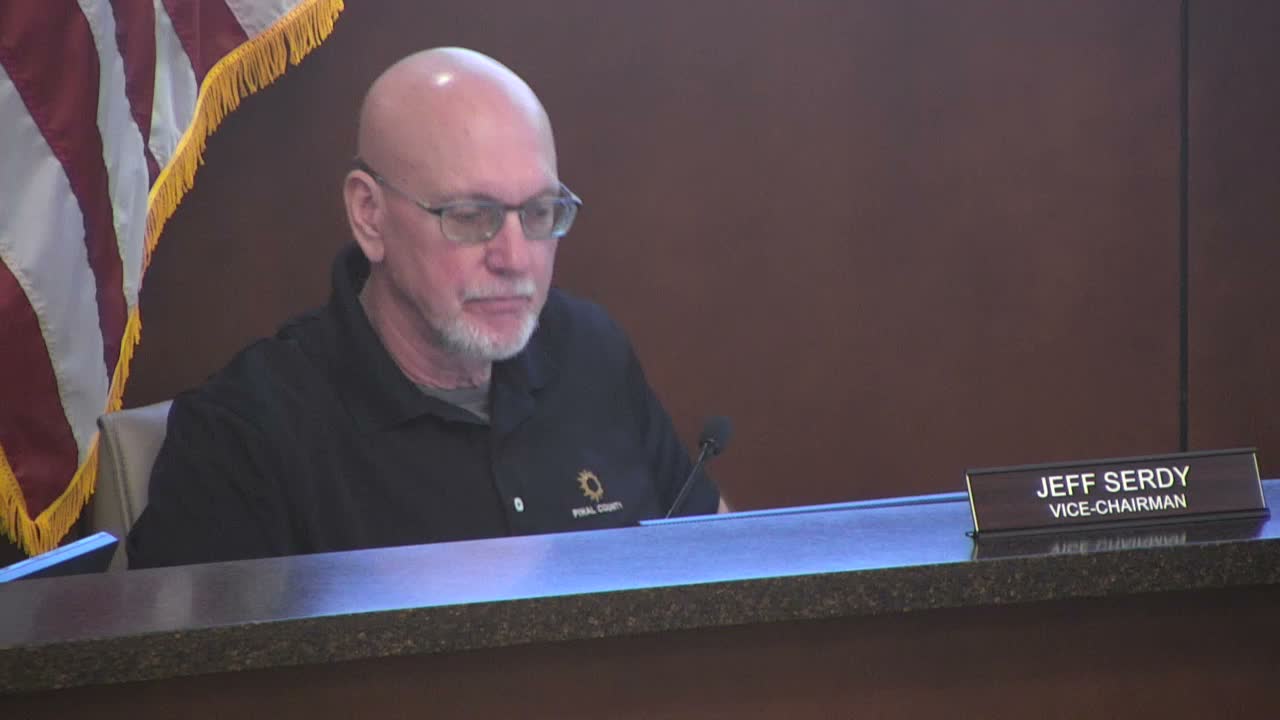
County Air Quality staff told the Pinal County Board of Supervisors on Feb. 18 that they are proposing a rule amendment to allow the control officer to make annual adjustments to stationary source permitting fees using the Consumer Price Index.
"The purpose of this rulemaking is to ensure the county can recover the average cost of services needed to administer stationary source air quality permits and perform inspections," Mr. Patel said. He described the proposal as an extension of an existing adjustment authority for Title V major sources to also include non‑Title V permits and said the mechanism is data‑driven and tied to CPI to keep fees aligned with inflation.
Patel presented comparative data showing Pinal’s hourly processing rate and emission fee per ton are substantially lower than those of ADEQ, Maricopa County and Pima County; he cautioned that undercurrent funding could create processing delays and staffing constraints. He said the adjusted fee schedule is planned to take effect on Jan. 1, 2027, and that the amended rule (Chapter 3, Article 7, Section 585 and a new Section 596) is scheduled for Board consideration on Feb. 18.
Board members asked how emissions‑based fees are billed. Staff explained emissions fees are calculated on an annual basis from measured tons of regulated pollutants and apply to major (Title V) sources; speakers said the district permits nearly 400 sources overall but invoices emissions‑based fees for roughly 22 major sources. Staff estimated roughly $200,000 in annual revenue from these emission fees but said the department budget is larger, and supervisors signaled a broader county review of low fee rates across departments.
Patel said the 30‑day public notice for the rulemaking began Nov. 27, 2025, notice was emailed to permittees and posted in local papers, and the district had received no public comments to date. He said the change is not intended to match other agencies dollar‑for‑dollar but to ensure the county can sustain timely and effective permitting services.
What’s next: The board is scheduled to consider the resolution at its next regular meeting on Feb. 18; staff indicated further analysis and outreach will continue.