Get Full Government Meeting Transcripts, Videos, & Alerts Forever!
Get email alerts on the Regional Transportation Plan topic
No spam. Unsubscribe anytime.
MAG outlines 2055 vision and near-term funding steps for Utah County transportation
Summary
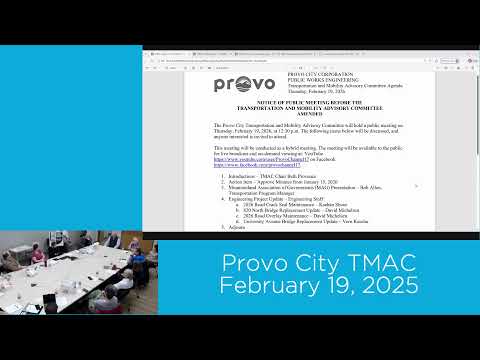
Bob Allen of the Mountainland Association of Governments told TMAC on Feb. 19 that MAG’s regional transportation plan (RTP) update will set a 30-year vision to 2055, must be fiscally constrained, and will feed a five-year Transportation Improvement Program (TIP) that programs project funding; Allen highlighted population growth to nearly 1.4 million in Utah County by 2055 and a planned North Utah County PEL study on a potential lake crossing.
Bob Allen, Transportation Improvement Program Manager for the Mountainland Association of Governments, told the Provo TMAC on Feb. 19 that MAG’s regional transportation plan update will set the region’s 30‑year transportation vision and determine which projects are eligible for near‑term funding.
"The RTP starts with you," Allen told TMAC members, describing the RTP as similar to a city’s general plan but focused on regionally significant roads, transit and active transportation. He said MAG breaks the 30‑year horizon into three 10‑year phases (Phase 1: 2026–2036; Phase 2: 2036–2046; Phase 3: 2046–2055) and must show realistic, fiscally constrained revenue assumptions.
Why it matters: Allen said growth drives the region’s needs — MAG and state projections show Utah County growing from under about 800,000 residents today to roughly 1.4 million by 2055 — and that the RTP and subsequent TIP process determine which projects get money and when. The TIP is the near‑term, five‑year capital programming document "where the rubber meets the road," Allen said, assigning specific funding and schedules to projects.
Key facts and funding roles
Allen described three practical steps in moving an idea to construction: identify a local need; include it in the RTP (the long‑range, fiscally constrained plan); and then program it in the TIP or through UDOT’s statewide process to obtain construction funds. He emphasized a difference in scale and role: MAG typically programs smaller regionally significant projects (Allen estimated average MAG projects in the mid‑single‑digit millions) and programs roughly $110 million every two years from federal, local and some state funds, while UDOT programs larger statewide projects (interchanges, freeways) through its own prioritization process with larger annual revenue.
Allen said MAG currently reports about $3.9 billion in programmed projects through 2031 in Utah County (MAGSTIP) and that MAG manages a limited programming pot (roughly $60 million a year under stewardship in a single cycle), meaning MAG aims to fill the "missing middle" of projects that are too large for a single city but too small for state funding.
Project eligibility, match and exchanges
Eligible MAG projects are regionally significant roads, intersections, regional trails and transit projects; local collectors and local trails generally are not listed in the RTP. Allen noted Utah’s federal match rate for many programs is unusually low (a local match of about 6.77% is used in many calculations) and described MAG’s practice of exchanging federal funds with UDOT — giving UDOT federal dollars and receiving state funds in return — sometimes accepting a roughly 15% exchange cost to avoid federal administrative requirements.
Modeling, congestion and phasing
MAG uses travel demand modeling (covering the Wasatch Front) built on local land‑use and jobs data to screen projects; Allen said phased model runs and corridor studies inform which projects move into Phase 1. He presented model outputs showing a much more congested 2055 if only currently programmed projects are built, and he tied the need for significant future investment to the region’s projected population growth.
I‑15 and a lake crossing: near‑term study
In response to TMAC questions about I‑15 expansion and an East Bay bridge, Allen said I‑15 in many Utah County locations is effectively at mainline capacity and that adding lanes can create more weaving and friction. He said an East Bay crossing is currently beyond the 30‑year horizon in MAG’s work but that a coordinated North Utah County Planning and Environmental Linkages (PEL) study — a joint MAG/UDOT effort — will evaluate the feasibility, costs and potential alignments for improved east‑west mobility, including possible crossings.
Next steps and public involvement
Allen said MAG is in the stage of screening the long list of candidate projects, prioritizing and phasing them, and preparing for fall outreach where communities will see where projects are landing. He said MAG aims to adopt the RTP in June 2027, and that project prioritization and phasing will be rolled out to cities in the fall as analysis solidifies.
Meeting business
Earlier in the meeting TMAC approved minutes from the Jan. 15 meeting by voice consent. The committee also noted a local "Gold Award" recognition for Provo’s active transportation work that staff will present to the City Council and mayor in early March.
The meeting closed after a brief question‑and‑answer period; TMAC will continue item 4 at the next meeting if needed.