Get Full Government Meeting Transcripts, Videos, & Alerts Forever!
Get email alerts on the Education Policy topic
No spam. Unsubscribe anytime.
State Board adopts final Ed 306 minimum standards after rule‑by‑rule review
Summary
After hours of line‑by‑line edits and debate about kindergarten numeracy, educator definitions and waiver language, the State Board of Education approved the final Ed 306 minimum standards for public school approval, subject to edits made at the meeting.
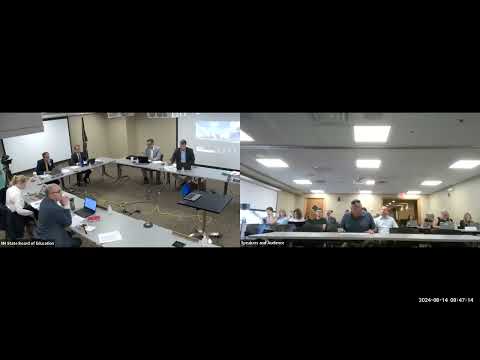
The State Board of Education voted Thursday to adopt the final proposal for Ed 306, the administrative rules setting minimum standards for public school approval, after a day of detailed edits and discussion about statutory fidelity and classroom requirements.
Board members and department staff spent much of the meeting reviewing text changes intended to improve clarity and ensure the rules mirror state law. Elizabeth Brown, counsel to the department, told the board staff had revised definitions — changing a principal term from “equity” to “equitable” for grammatical consistency — and added clarifying language to the waiver criteria to require that a district’s “reasonable basis” for a waiver be consistent with RSA 189:11‑a.
The debate touched on several substantive points. Representative Dave Luna, a member of the House Education Committee, urged the board to respect the Legislature’s oversight role and noted the Joint Legislative Oversight Committee had not completed a comprehensive review of the draft when it last met. Several board members pressed staff to make explicit how the rules align with the state academic standards so districts would not be confused about whether to teach certain kindergarten content such as early numeracy.
A recurring concern came over the definition of “educator” used for student‑educator ratios. Some members worried the broad definition — which can include credentialed or otherwise state‑recognized staff — could allow districts to count paraprofessionals in ways that were unintended. Staff noted the certificate of eligibility and other credentialing requirements still limit who may be placed in front of a class, saying the rule as drafted would not permit simply assigning a nurse or other non‑certified staff member to lead a classroom without meeting licensure criteria.
After the discussion, a board member moved to approve the final proposal for Ed 306.02–306.26 “subject to the edits that were made to the document today.” The motion was seconded and adopted by voice vote. The adoption record in the transcript reflects a voice roll call of “Aye”; no individual roll‑call tally was captured in the public transcript.
What happens next: staff will incorporate the grammar, citation and clarifying edits discussed at the meeting into the final rule language and proceed with the administrative process for publication and implementation. Several board members said they will monitor whether districts apply the educator‑counting language in ways that require further rule refinements.
(Attribution note: several formal motions and the vote were recorded in the meeting transcript without a full, individual roll‑call tally or a mover’s full name; the transcript identifies the motion by speaker number rather than a spoken full name.)