Get Full Government Meeting Transcripts, Videos, & Alerts Forever!
Get email alerts on the Special Education topic
No spam. Unsubscribe anytime.
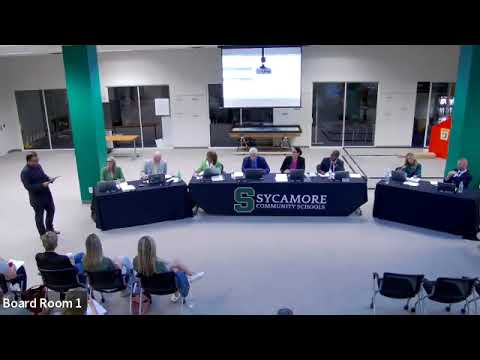
Sycamore board hears special-education briefing as officials flag disproportionality and rising costs
Summary
The Sycamore School Board received a detailed special-education update from Executive Director Stacy Spencer showing 594 students identified with disabilities, higher-than-average autism identification, rising contracted-service costs and planned internal monitoring to address racial disproportionality.
Stacy Spencer, the district’s executive director of student services, told the Sycamore School Board at its September meeting that the district served 594 students with disabilities in the 23–24 school year and that overall identification represents about 10% of enrollment compared with the state average of 16.8 percent. Spencer said federal law — "the Individuals with Disabilities Education Act, or IDEA" — requires annual IEPs and timely evaluations and that some indicators used in state performance profiles use lagging data.
The presentation outlined district staffing and services: 73 special-education teachers, roughly 30.6 related-services FTE (speech, OT, PT and similar) and about 111 educational assistants who support students across preschool to transition programming. Spencer described a continuum of supports — in-class inclusion, co-teaching, pull-out resource rooms and specialized classrooms — and said 78 percent of preschool-age students with disabilities receive services inside general-education classrooms, while roughly 69 percent of school-age students spend most of the day in general education.
Spencer said the district’s autism identification rate is “almost twice state average” and that the district also has recurring state findings of disproportionality in identification and discipline for Black students, especially in categories including specific learning disability and emotional disturbance. "We are addressing that by monitoring our evaluation and eligibility paperwork and by strengthening MTSS and internal review processes," she said.
On funding, presenters said the state and federal governments cover a minority of special-education costs. Spencer noted the district receives roughly $1,800,000 in federal funds plus smaller preschool allocations and pursues state "threshold cost reimbursement" to recoup eligible expenses; the district also pursues small grants (Spencer cited an $11,000 job-skills grant) and sometimes contracts services when staff are on leave. Board members asked whether scholarship programs such as the John Peterson and autism scholarships come from district coffers; Spencer said those scholarship dollars are state-funded but the district remains responsible for conducting annual IEPs for scholarship recipients.
Spencer described specific programming and capacity: specialized classrooms are located at Blue Ash, Mapleville, Montgomery, Sims, Green, the junior high and high school, with 81 students in specialized classrooms and 22 students in behavior-support programming across the district. She said some students are placed out of district when needs require therapeutic settings beyond district capacity, and the district supplements classroom teams with external therapy providers as needed.
The presentation covered accountability and ratings. Spencer said the district met targets on some indicators, noting a 4‑year graduation rate of about 78.5 percent for students with disabilities where the state target was 64 percent, and said zero students were recorded as dropouts for that cohort. She cautioned that profile ratings rely on old data and that corrective-action timelines can lag implementation.
Next steps outlined by the presenters include continued professional development and coaching for staff (including BCBA coaching), internal monitoring of evaluation paperwork led by district leaders, renewed community engagement and a group-level assessment that Spencer said the district has not conducted since 2018. The district plans to return to the board with additional detail and timeline for corrective actions and monitoring.
The presentation and board discussion ran about an hour; no formal vote followed the update. The board thanked staff for the thorough report and asked for comparative data and additional budget detail to be included with the five-year forecast planned for the next meeting.