Get Full Government Meeting Transcripts, Videos, & Alerts Forever!
Get email alerts on the Water Supply topic
No spam. Unsubscribe anytime.
Valley County Water District marks 100 years and warns of invasive mussel, groundwater shifts
Summary
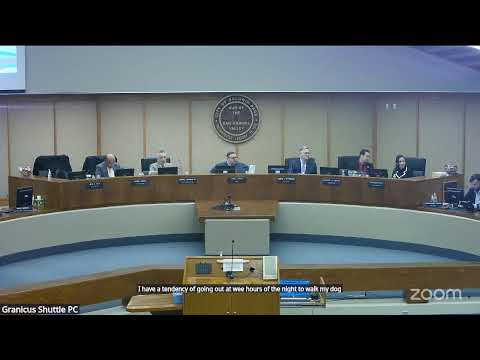
At the Baldwin Park City Council meeting, Valley County Water District General Manager Jose Martinez outlined the district’s centennial, current groundwater gains, and threats from invasive mussels that have curtailed spreading of some imported state water; he also described regional recycled-water plans.
Valley County Water District officials told the Baldwin Park City Council on Feb. 18 that the district is celebrating its 100th anniversary and that recent rainfall has boosted local groundwater levels.
"The district is actually celebrating our 1 hundredth, year anniversary," Jose Martinez, general manager, said during a presentation that summarized staffing, service area and reservoir statistics. He said the district serves a population just under 70,000 and employs about 31 full‑time staff.
Martinez said groundwater is showing strong recovery after recent storms. "So right now our current level is about 261 feet," he said, and reported rainfall totals near 16 inches for the water year, numbers he described as above typical averages.
But Martinez emphasized an emergent operational challenge: invasive mussels in the statewide conveyance system. "This golden mussel...has made its way across the state and down the California Aqueduct," he said, and explained the result: county authorities have restricted spreading of some imported water to limit mussel spread. That restriction, he said, constrains a source of replenishment the district uses in dry years.
Martinez described two mitigation paths: treatment technology on large conveyance lines or active removal and cleanup, both of which carry uncertain costs. He cautioned that statewide estimates vary and said Metropolitan Water District mitigation work offers the most realistic cost references for the region.
He also highlighted regional recycled‑water efforts, including Pure Water Southern California, which he said could provide an additional supply—"another 150,000,000 gallons"—that would reduce dependence on the State Water Project.
Councilmembers thanked Martinez and asked follow‑up questions about the groundwater observation points and cost exposures. Martinez said agencies are coordinating—local districts, the county, Metropolitan and state partners—to pursue federal and regional funding and to reduce impacts on local ratepayers.
The presentation concluded with an invitation to the community to join the district’s May 16 centennial celebration and with a brief discussion of public outreach and conservation workshops the district plans to run.
What happens next: the Valley County Water District will continue coordination with regional agencies on mussel mitigation and with Baldwin Park staff on public outreach and potential rate impacts; the council did not take action beyond receiving the presentation.