
Placer County adopts broad 2025 code amendments, including ADU, agricultural split and tiny-home rules
Get AI-powered insights, summaries, and transcripts
Subscribe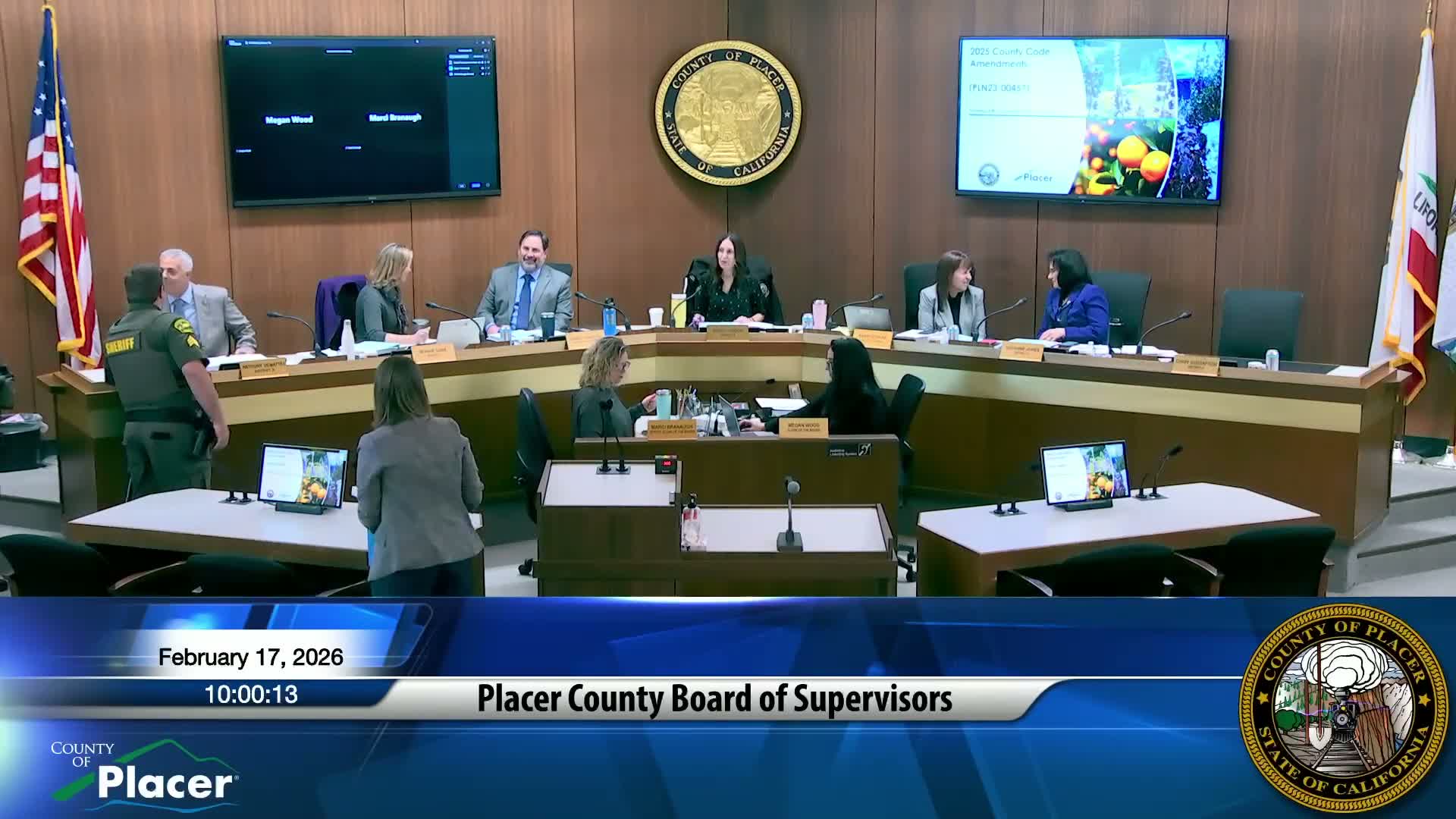
Summary
Supervisors adopted a 23-item Placer County code amendment package on Feb. 17 that updates ADU porch rules, creates a 95% minimum-parcel-size pathway for limited agricultural splits, sets standards for electrified security fencing in nonresidential zones and revises movable tiny-home standards to rely on national standards with local snow-load equivalency.
After a staff presentation and public hearing, the Placer County Board of Supervisors on Feb. 17 adopted a package of 23 code amendments intended to clarify land-use regulations and correct inconsistencies in Chapter 9 and Chapter 17 of the county code.
Key amendments approved include:
- Accessory dwelling unit (ADU) unenclosed porches: staff removed a restriction that limited an unenclosed ADU porch to 25% of the ADU's floor area, allowing more usable interior ADU space while retaining porch allowances.
- Electrified and barbed security fences: the package creates standards for such fencing in commercial and industrial zones, prohibits them in residential or agricultural zones and sets marking and height requirements.
- Minimum parcel-size deviation (95% rule): property owners with parcels in agricultural-exclusive, farm or forest zones that are within 95% of twice the minimum parcel size may be eligible for a one-time split (one parcel to two), subject to criteria including a prohibition on resplitting, a five-year limit since the last split, exclusion of Williamson Act lands, and proof of sufficient water rights for both resulting parcels.
- Movable tiny homes: the county revised the movable tiny-home provisions to rely on ANSI and NFPA national standards (rather than the California Building Code) for fire, wind and snow performance, while retaining a local requirement that tiny homes provide equivalent snow-load performance to residential structures at the site. Staff explained the change aims to allow legal inspection and safety oversight while addressing Tahoe-area snow-load needs.
Staff described a multiyear outreach process that began in 2024 including a workshop, agricultural commission input and planning commission review; the planning commission recommended the package unanimously (with two members absent). Several public commenters urged adoption and noted implementation issues for tiny homes in high-snow areas, including increased engineering costs tied to updated ASCE snow-load standards.
The board opened the public hearing, heard comments from resident advocates and housing stakeholders (including Erin Casey of the Tahoe Housing Hub), and adopted ordinance language as read into the record. Staff cited CEQA Guidelines section 15061(b)(3) (general rule exemption) in presenting the environmental finding.