Get Full Government Meeting Transcripts, Videos, & Alerts Forever!
Get email alerts on the Fafsa Guidance topic
No spam. Unsubscribe anytime.
Stevenson hosts FAFSA workshop; presenter urges families to create FSA IDs before Dec. 1
Summary
At an Adlai E. Stevenson HSD 125 information night, a Lake Forest College financial‑aid official explained FAFSA changes and timelines, encouraged early FSA ID creation and CSS/Profile completion for some colleges, and announced a hands‑on help night Dec. 17 by appointment.
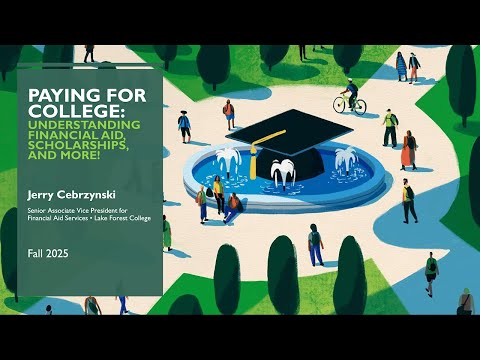
Adlai E. Stevenson High School hosted a packed FAFSA and financial‑aid information session on a Monday evening where a Lake Forest College financial‑aid official reviewed the reworked FAFSA timeline, how to interpret college award letters and where families can get help.
"Ask me anything," the presenter said, urging questions throughout his talk as he explained that the FAFSA for the upcoming award year will be available Dec. 1 and that families should create Federal Student Aid (FSA) IDs well in advance because verification can take up to 72 hours. He told families that most first‑year students receive some form of financial aid and that much of the assistance is gift aid — grants and scholarships that do not have to be repaid.
The presentation covered practical tools and steps parents can use to compare offers. The presenter demonstrated College Navigator and the College Scorecard as ways to check a school's enrollment, graduation rates and median earnings for graduates. He highlighted the net‑price or net‑cost calculators on college websites and advised families to plug in their own data to get an accurate picture of likely out‑of‑pocket costs.
He described the main types of financial aid — federal, state, institutional and outside scholarships — and distinguished merit‑based awards (tied to a student’s strengths) from need‑based grants. He noted the Illinois Monetary Award Program (MAP) grant is available to eligible Illinois residents and said eligible students can receive over $8,000 at any Illinois college that participates.
On process details, the presenter explained the FAFSA's Direct Data Exchange (DDX), which imports IRS income information into the form, and warned families that the FAFSA will request student and parent identity data and that only one parent needs to sign in as a contributor. He recommended using Google Chrome on a desktop or laptop for the best experience and discouraged using tablet browsers or autocompletion when entering personal information.
During a question‑and‑answer period, parents asked whether outside scholarships reduce institutional offers; the presenter replied that, in nearly all cases, small outside awards do not cause colleges to reduce institutional aid, though very large external awards could affect an institutional package at some schools. He also answered questions on how assets (bonds, stocks, or the equity in a brick‑and‑mortar business) are treated on the FAFSA, how students with court‑appointed legal guardians are considered independent for FAFSA purposes, and where to begin with 529 plans.
Dan Miller, a Stevenson post‑secondary counselor who opened and closed the session, reminded families that the recorded presentation will be posted to the school's website in the following days and that the school will host a hands‑on FAFSA/Illinois alternative aid assistance night on Dec. 17 by appointment. The presenter encouraged families to raise special circumstances — such as recent income loss or emergency expenses — with colleges directly, since many institutions have supplemental forms (for example, the CSS Profile) or internal processes to consider those factors when packaging aid.
The event provided local families with step‑by‑step guidance on completing the FAFSA and other forms and where to seek follow‑up help from school counselors and college financial‑aid offices.