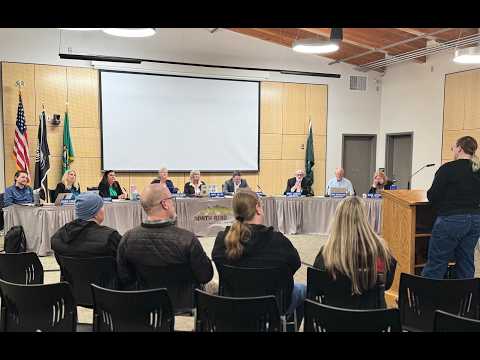
North Bend council approves multiyear water and sewer rate increases after extended debate
Loading...
Summary
After a multihour public hearing and detailed financial briefing, the North Bend City Council unanimously approved ordinances raising water and sewer rates through 2030. Council members pressed staff for mitigation for low-income households and committed to follow-up analyses and outreach.
The North Bend City Council voted unanimously Feb. 17 to approve ordinances raising water and sewer rates through 2030 after a two-part public hearing and extended council discussion.
Finance Director Martin Cha presented the rate study and explained the proposal would raise water rates by 6.5% annually beginning in 2026 (through 2030) and apply smaller, staged increases to sewer rates (roughly 2.4—2.5% through 2026 and 3% annually thereafter). Cha said the study aims to “ensure financial sustainability for both utilities, maintaining quality drinking water and services to the community, as well as maintaining our debt covenants and the city's positive double A minus credit rating.”
The presentation compared actual and forecasted general facility charge (GFC) collections and operating revenues for 2021—2025 and showed GFC receipts and service-charge collections had tracked within forecast ranges. Cha and the consulting team told council GFCs are sensitive to development activity and that the water utility's capital-improvement program includes major projects (including water-main replacements) that drive the proposed increases.
Public comment focused tightly on affordability and the timing of technical studies. Resident George Anderson warned that North Bend's water rates were already “approximately 10% higher than our next highest-priced municipality, Sammamish,” and urged caution before further increases. Nic o la Overstreet, who identified housing affordability research in 2023, said she was “worried the most about the outsized impact that utility rate increases have on lower-income households” and pressed the council to consider mitigation measures. Michael Thomas, speaking online, asked the council to wait for the WSP study update on mitigation operations and to include 2025 data in the analysis before codifying rate benefits.
Council members raised similar equity concerns during deliberation. Several asked staff to explore ways to reduce impacts on cost-burdened households, including revising the city's Low Income/Senior discount and expanding outreach. Cha told the council the city offers an annual application for a 50% utility discount for income-qualified account holders and that staff will advertise the program; he said the discount requires proof of household income and that the city would present options for revising eligibility.
Council members also pressed staff on technical drivers of the proposed increases. Cha, supported by consultant comments, explained that utility funds are separately managed and that timing of capital projects and the need to address deferred maintenance (including aging asbestos-cement mains, distribution system losses and valve/hydrant maintenance) contributed to the higher water trajectory. Council members discussed options to push lower-priority capital projects later in the study window and to run alternative scenarios tied to different acceptable annual rate ceilings.
After the discussion Council member Rustic moved to adopt AB 26-019 (water rates) as a second and final reading; Council member McFarland seconded and the motion passed unanimously. The council then approved AB 26-020, a parallel ordinance increasing sewer rates, by unanimous vote.
The council directed staff to return with scenario analyses and to place review of the discount program and other mitigation options on the Finance & Administration committee calendar for the budget cycle. The ordinances take effect as written in the city's taxes, rates and fees schedule through the planning window covered by the rate study.
Next steps: staff said they would update comparative materials as neighboring jurisdictions publish revised rate schedules, run alternate rate scenarios at council direction, and present recommendations for outreach and possible adjustments to the city's low-income discount eligibility.