
Augusta officials briefed on RHID plan, bond counsel warns early years pose most risk
Get AI-powered insights, summaries, and transcripts
Subscribe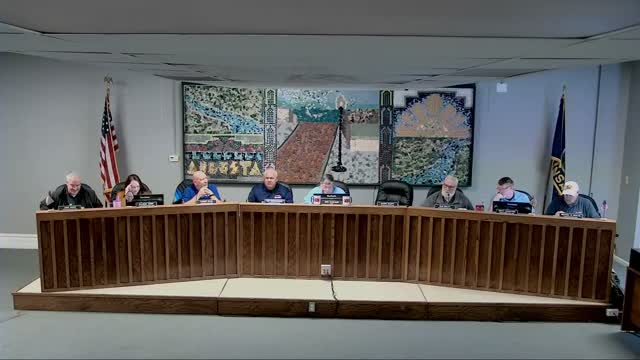
Summary
City staff and bond counsel outlined a plan to use a reinvestment housing incentive district (RHID) and special assessments to support a proposed 22-unit development at David and Ohio Street; next steps include feasibility work, a developer agreement and a public hearing, with letters of credit and temporary notes highlighted as early safeguards.
Kevin Cowan, the city’s bond counsel, told the council that a proposed reinvestment housing incentive district (RHID) for a 22‑unit project at David and Ohio Street would operate “at their core [as] tax increment finance,” capturing new incremental property taxes to help pay infrastructure costs.
“This is purely an informational educational session,” a city staff member said at the start of the briefing, framing the meeting as preparatory rather than a request for immediate action. Cowan explained that the RHID mechanism can capture 100% of the incremental property taxes generated by a project for up to 25 years and that certain statewide levies — including the school levy referenced in the presentation — are protected and not part of the increment.
Cowan described permitted uses under the statute as largely infrastructure‑focused — site preparation, sanitary and storm sewers, street grading and water mains — but noted more recent statutory updates allow rehabilitation of upper‑floor residential space and some vertical construction costs in certain circumstances. He used a numerical example to illustrate how a $1,000,000 after‑development assessed value could produce an annual increment the city would control (presented in the session as roughly $79,900 after protected school levies) and showed how that increment could reduce the annual special assessment on the property.
To bridge remaining costs, Cowan and staff described a layered model in which the city could issue temporary financing and then use either the captured increment or a special‑assessment benefit district — with property owners petitioning to subject parcels to assessments — to service permanent debt. “You reduce the annual assessment by the amount of any increment we have on hand,” Cowan said, describing a scenario where a $100,000 annual assessment could be reduced by an $79,900 increment to produce a net assessment of about $20,100 in that year.
Council members pressed staff on early‑stage risk if the homes do not sell as anticipated. One council member asked, “What happens if we don’t sell those 22 lots up there? What’s our safety net?” Staff replied that the city would require developer security such as letters of credit and that temporary notes (discussed at three years in the briefing) allow interest‑only payments while some build‑out occurs. Cowan said those early years are the highest risk: if development lags, the city may have to make debt service payments until absorption increases increment revenue.
Staff reported that the project team has already briefed Butler County commissioners (who expressed support) and a school‑district subcommittee (which gave preliminary support), and that a full school‑board presentation is expected. Cowan reviewed procedural steps required by statute: identify the property and housing need, make findings, send a resolution to the Kansas Department of Commerce for review, accept a development plan and call a public hearing (the briefing specified the law requires a public‑hearing date between 30 and 70 days after calling the hearing). After the hearing, other taxing subdivisions have a 30‑day window to file an adverse finding that would nullify the ordinance.
A council member raised concern about state legislation referenced in the session as “house bill 27 45,” saying that if the bill reduces local home‑rule authority the city’s ability to respond to RHID‑related obligations could be constrained. Staff acknowledged that state policy changes are an external risk to be monitored.
City staff and bond counsel said the immediate next steps are to build a developer agreement and a feasibility study, produce infrastructure cost estimates and then return to council with a resolution to call a public hearing. No ordinance establishing an RHID or any financing was approved at the meeting; the session was informational. The meeting concluded with a motion to adjourn, which passed.