
Milpitas council expands MAP utility-bill subsidy, removes first-year cap
Get AI-powered insights, summaries, and transcripts
Subscribe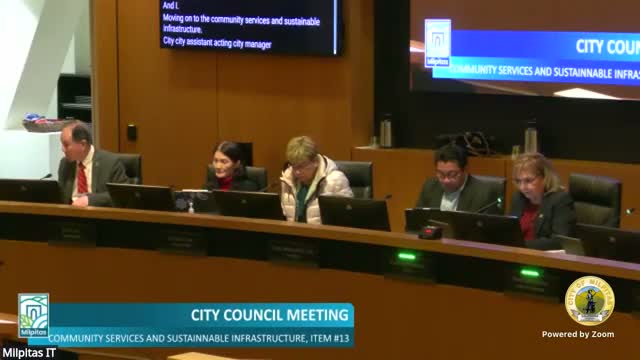
Summary
The Milpitas City Council unanimously approved a tiered increase to the Milpitas Assistance Program (MAP) water-utility subsidy, removing a first-year participant cap and authorizing the city manager to pause enrollments if costs threaten Fund 109 revenues.
Milpitas — The City Council voted unanimously to expand the city’s Milpitas Assistance Program (MAP) water-utility subsidy and to remove a proposed enrollment cap for the first year while authorizing the city manager or designee to suspend new enrollments if projected expenditures appear likely to exceed projected revenues. The action followed a staff presentation that modeled a tiered 50/30/20 subsidy for qualifying households.
Renee Lorentz, director of recreation and community services, told the council staff analyzed 205 participating households using recent water-consumption data and modeled a three-tier structure: tier 1 would receive a 50% discount on meter and sewer fees plus up to $50 off consumption charges; tier 2 would receive 30% discounts; tier 3 would receive 20% discounts. Lorentz said the modeled annual cost for customer subsidies under the proposal is $152,973 for FY 2026–27.
Lorentz also outlined implementation costs: a one-time billing-system configuration (Kayenta) estimated up to $40,244 and one-time deployment staff support of $11,314, for a total upfront admin estimate of $51,558; ongoing staff administration was estimated at $43,000 annually. The staff recommendation said the program would be funded from water-bill late fees deposited in Fund 109, which had a balance of $909,751 at the close of FY 2024–25 and projected ongoing late-fee revenue of about $321,500.
"The recommendation tonight is to approve the increase to the MAP water utilities bill subsidy amount," Lorentz said. Acting City Manager Jared Hernandez acknowledged residents’ concerns about timing and process and said, "It's not falling on deaf ears. It is being listened to," while committing a staff information memo to the council in the coming days.
Council members pressed staff on enrollment assumptions. Staff said the 205-household figure was a three‑year average used for modeling; current enrollment is higher (236–238 households), and adding roughly 33 households would increase ongoing annual costs by approximately $26,500. Finance Director Luz Cafressiha told the council Fund 109 accrues interest (roughly 4%), and staff said they would monitor enrollment and consumption patterns and return to council if revenues no longer covered expenditures.
Councilmember Lam moved to approve the increase with two modifications: remove the enrollment limit for the first year and authorize the city manager/designee to suspend new enrollments if projected annual expenditures may exceed projected revenues. Councilmember Chua seconded; the motion passed unanimously.
The council did not set a permanent enrollment cap. Staff will begin implementation work — including Kayenta configuration and expanded outreach to eligible households — and report back if enrollment or fund performance requires further action.